

ARC Markets is an online broker claiming years of experience and FSCA regulation; however, its actual digital footprint raises questions. In particular, the scale of operations and history claimed by the company diverge significantly from what can be found in open sources. Let us examine this information in greater detail.
- ARC Markets: Regulatory and Operational Risk Profile
- Does ARC MARKETS (PTY) LTD Really Back the Broker?
- Does ARC Markets Really Have 7+ Years of Experience?
- Referral Scheme and B-Book Model: What’s Wrong with ARC Markets?
- ARC Markets Trading Conditions: What Does the Broker Offer?
- Deposits and Withdrawals: Where Are ARC Markets’ Documents?
- Recommendations for Investors
- Marketing Claims and Revealed Reality
ARC Markets: Regulatory and Operational Risk Profile
| Target Brand & Domain | ARC Markets (arcmarkets.com) |
| Risk Index | High risk |
| Legal Entity & Stated Jurisdiction | ARC MARKETS (PTY) LTD (South Africa) |
| Regulatory Status & License | Unverified |
| Regulatory Blacklists | Not listed |
| Domain Age vs Claimed History | Updated: 27/06/2026 (Claimed: 7 years) |
| Trading Platform Software | Unknown |
| Deposit Methods & Chargeback | Closed Client Area (Chargeback unknown) |
Does ARC MARKETS (PTY) LTD Really Back the Broker?
The company claims to be registered in South Africa and licensed by the Financial Sector Conduct Authority (FSCA). We verified this information against the regulator’s official registry to determine whether the stated information was accurate.
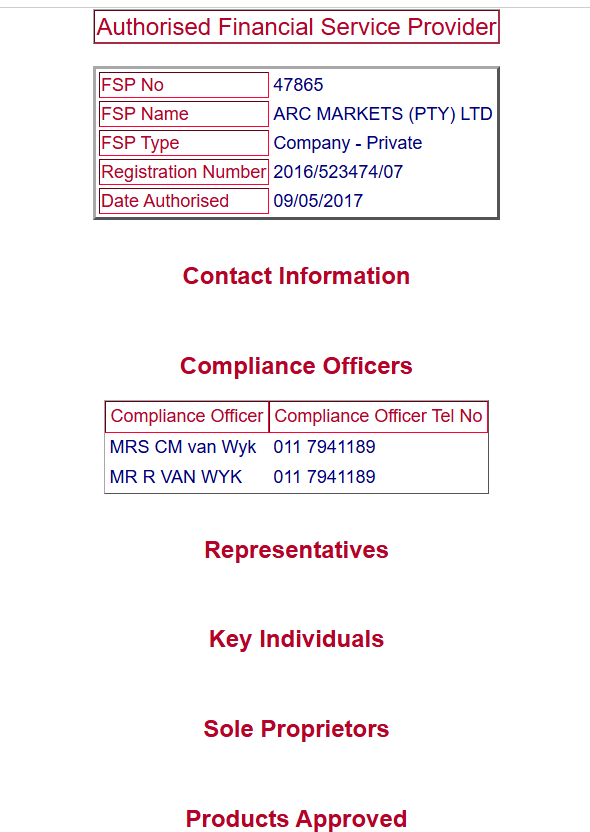
The check revealed that the legal entity ARC MARKETS (PTY) LTD does exist and is listed in the FSCA registry. The regulator provides the following information: FSP No. 47865, name: ARC MARKETS (PTY) LTD, type: Company – Private, registration number: 2016/523474/07, authorization date: 09.05.2017.
A South African FSCA license is issued to a specific legal entity and within a specific set of permitted financial services, so it is necessary to verify not only the existence of the FSP but also whether the domain being checked is associated with this company. Unfortunately, this registry does not directly list the websites owned by brands.
This is especially important because the actual details of licensed companies are often used by third-party clone projects. A fraudulent platform may use the name of an existing FSP, its registration number, and license number to create the appearance of regulation. Therefore, matching the details in the registry is only the first step in verification, and does not prove that the broker is legitimate.
Furthermore, the presence of an FSP in South Africa does not mean that the FSCA has authorized the broker to work with clients from any country or that a specific website is automatically affiliated with a licensed legal entity. Therefore, it is necessary to compare the broker’s domain, the permitted activities of ARC MARKETS (PTY) LTD, and the information published by the FSCA about the licensed provider. If the official registry does not link this domain to ARC MARKETS, and the broker does not provide a copy of the license and other documents confirming the connection with the company, there is insufficient grounds to conclude that regulation has been proven.
At the same time, the Client Agreement makes additional and unexplained reference to Vanuatu. However, the corresponding organization could not be found in either the register of financial dealers or the register of companies in Vanuatu.
Does ARC Markets Really Have 7+ Years of Experience?
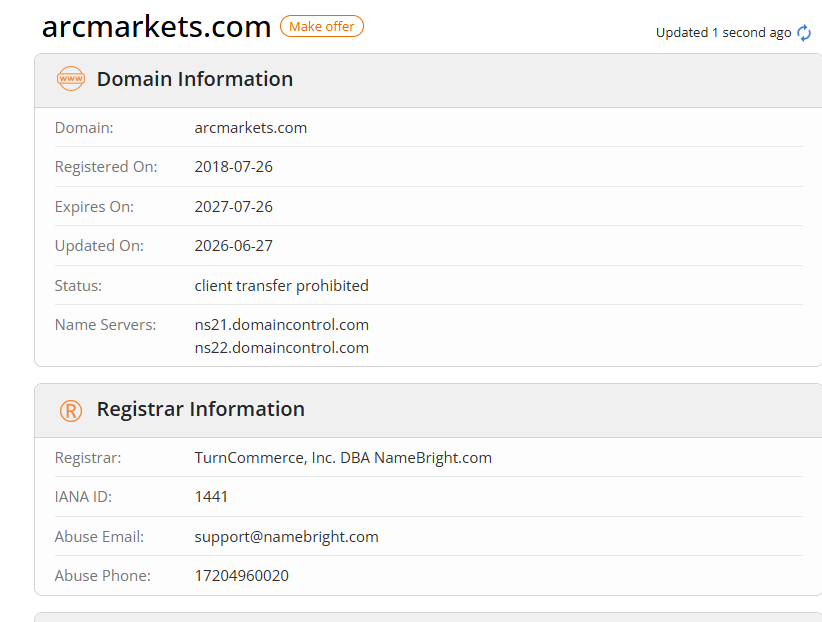
On its website, the broker claims to have been in business for over 7 years, but a review of its digital footprint raises many questions. This figure appears plausible: the legal entity ARC MARKETS (PTY) LTD was registered back in 2016, and Whois data shows that the domain was registered in 2018. This suggests, if one were to speculate, that the brand has indeed been online for approximately 7-8 years.
But this is where the most interesting inconsistencies begin. According to Web Archive data, full content for the ARC Markets website only appeared in 2026. We found no earlier traces of this particular brokerage project. This creates a strange picture: the legal entity has existed since 2016, the domain since 2018, yet a convincing digital footprint only emerges many years later.
The review history also doesn’t support the stated length of service. Searching for mentions of ARC Markets online, it’s virtually impossible to find client reviews from previous years. The first notable publications only began appearing in 2026, even on platforms like Trustpilot. For a broker that claims to have been operating for over seven years, such a late client trail appears highly unusual.
Therefore, we cannot confirm the claimed 7+ years of experience with independent data. The company’s registration and domain age do suggest a fairly long history, but Web Archive and review history do not support this theory. Therefore, we would be extremely cautious about ARC Markets’ claim of extensive experience.
Referral Scheme and B-Book Model: What’s Wrong with ARC Markets?
ARC Markets demonstrates a rather unusual approach right from the registration stage. To create an account, one must provide a CPF (invitation code); in fact, completing the registration is impossible without it. This clearly indicates the existence of a referral system, yet the broker offers no explanation as to why an ordinary client would require an invitation to open a trading account.
Mandatory referral-based registration is, in itself, a serious cause for concern and deserves attention in any ARC Markets review. With a legitimate broker, a client can typically open an account independently on the official website, complete the necessary verification checks, and begin using services without the involvement of an intermediary or the need for a personal promo code.
Requiring an invitation creates an additional barrier while simultaneously allowing the broker to control the flow of new clients through the referral network. Needless to say, this falls outside the standard practices of a reputable, regulated broker.
The website does indeed describe a referral program. ARC Markets offers clients and partners the opportunity to earn commissions for bringing in new users via a personal link. The broker promises no minimum investment or experience requirements, real-time income tracking, and automated payouts. Partners are also offered regular commissions for each active client, along with marketing tools and support.
Even more questions arise when considering the broker’s “B-book” operating model. In this model, the broker acts as the counterparty to client trades, meaning a client’s profit effectively becomes the broker’s loss. This creates an obvious conflict of interest. The company is incentivized not only to attract new clients and their deposits but also to ensure that clients continue trading and incur losses.
The result is a system where an acquired client generates revenue for both the platform and the referral network participant, while the broker simultaneously has a vested interest in the client suffering trading losses.
ARC Markets Trading Conditions: What Does the Broker Offer?
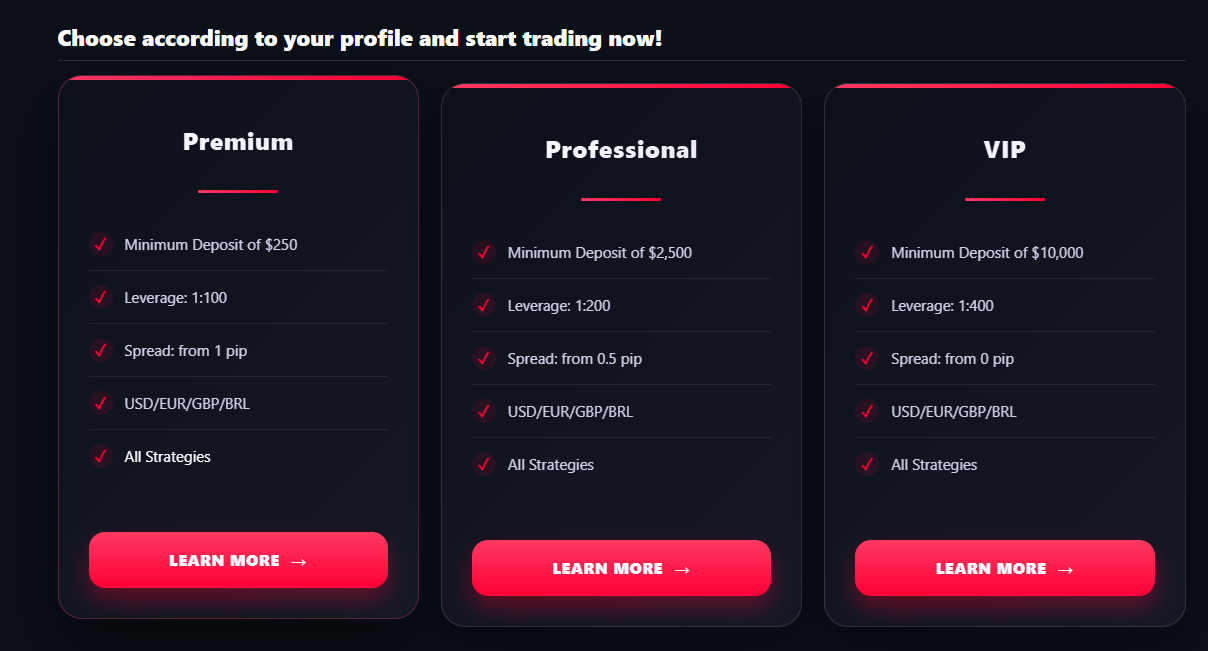
ARC Markets offers three account types, Premium, Professional, and VIP, with conditions varying significantly based on the initial deposit amount.
- Premium: minimum deposit of $250, leverage up to 1:100, and spreads starting from 1 pip.
- Professional: minimum deposit of $2,500, leverage up to 1:200, and spreads starting from 0.5 pips.
- VIP: minimum deposit of $10,000, leverage up to 1:400, and advertised spreads starting from 0 pips.
USD, EUR, GBP, and BRL currencies are available for all account types, and the broker states that any trading strategy may be used.
However, the broker does not disclose all conditions on the main page. A “Learn More” button reveals additional details, including information on bonuses, client area support, and inactivity fees. Limits are also set on the maximum number of simultaneously open orders.
Overall, the fee structure is standard for the brokerage market: the larger the deposit, the higher the available leverage and the lower the advertised spread. However, one should pay close attention to terms like “from 0 pips” and “from 0.5 pips” — the minimum spread does not indicate what the actual spread will be during normal trading.
Furthermore, the information provided regarding trading conditions cannot be considered comprehensive. In effect, the broker has limited itself to a few metrics most attractive to potential clients — minimum deposit, maximum leverage, and advertised minimum spread — while leaving a significant portion of truly important trading parameters undisclosed. In particular, the broker fails to provide comprehensive information regarding order execution types, the existence and size of commissions, actual average spreads, potential restrictions on trading strategies and instruments, order execution rules, slippage, margin requirements, stop-out and margin call levels, minimum order placement distances, limitations on hedging and scalping, and other conditions that directly impact trading costs and risks.
Yet, the website explicitly claims transparency regarding prices and commissions — a statement that appears particularly odd given such incomplete disclosure of terms.
Consequently, while it is possible to compare accounts based solely on published figures, it is virtually impossible to assess the actual cost of trading or to compare ARC Markets’ offerings with the terms provided by other brokers. For the client, this represents a significant drawback: the “shop window” displays attractive figures, but the full picture regarding expenses and trading risks remains missing.
Deposits and Withdrawals: Where Are ARC Markets’ Documents?
ARC Markets claims that client funds are fully segregated from operating capital and held in segregated accounts at Tier-1 banks, with their safety further monitored by external and internal audits. The website also details the data protection technologies used and even names the auditing firms. However, it is impossible to verify these claims.
The main issue is the complete absence of proper documentation governing the broker-client relationship. There is no standard Client Agreement, no comprehensive Terms & Conditions, no separate policy on deposits and withdrawals, and no rules regarding payment processing. Essentially, clients are asked to take the company’s word for it, without any documents outlining its obligations.
This is particularly strange regarding withdrawals. The website lacks a clear description of:
- Available deposit and withdrawal methods.
- Transaction fees.
- Request processing times.
- Minimum and maximum withdrawal amounts.
- Potential restrictions.
- Refund conditions.
- Payment rejection procedures.
- Requirements for verifying the source of funds.
- Conditions under which the broker may delay or reject a withdrawal.
Furthermore, we cannot independently check the payment process within the personal account area: registration with ARC Markets requires a mandatory invitation code. This means a potential client cannot simply open a demo account to review available payment methods and withdrawal rules beforehand.
The result is a rather peculiar situation. ARC Markets speaks at length about the security of client funds, account segregation, and audits, yet fails to provide even the basic documents that would allow a client to understand exactly how they can deposit and withdraw their money.
Recommendations for Investors
ARC Markets does not appear to be a platform that warrants unconditional trust based solely on its claim of holding an FSCA license. While the existence of a genuine FSP license (No. 47865) should be acknowledged, there is no conclusive evidence linking this specific domain to the licensed legal entity or confirming that the services offered fall within the scope of its authorization.
We advise potential clients to refrain from depositing funds until the broker’s connection to ARC MARKETS (PTY) LTD, its actual regulatory status, and the terms regarding client fund protection have been verified. You should not provide the company with personal documents or data simply to gain access to the trading platform.
If you have already registered and deposited funds, you should first attempt to withdraw your money and ensure you save all correspondence, payment records, and account details. Should withdrawal issues arise, do not transfer additional funds under the pretext of paying taxes or fees, or to unblock your account.
Marketing Claims and Revealed Reality
The people who worked on the review
Each Broker Expert Audit review is based on publicly available evidence, including the broker’s website and legal disclosures, regulatory registers and official warnings, corporate and domain information, trading conditions, payment policies, and relevant user reports. Our writers investigate the available evidence, while editors fact-check key claims, verify sources, and ensure that risks and uncertainties are explained clearly. Read our full Methodology of Our Reviews.
Katherine Mercer is a financial editor and fact-checker with over a decade of experience handling brokerage claims and regulatory information. With a background in economics and financial compliance, she verifies the accuracy, consistency, and risk disclosure of all investigative articles. Her purpose is to ensure that each review is accurate, sourced reliably, and technically sound.
More about me →
I initially thought ARC Markets had put serious effort into the design of their site. However, after taking a closer look, my impression changed. Almost every page is filled with talk about the platform’s advantages, service quality, and opportunities for traders. The problem is that it’s quite difficult to find truly important, practical information amidst all that. I’m always interested in the technical side of a broker’s operations. How does order execution work? What are the limitations on specific instruments? Are there extra account maintenance fees? The site answers many of these questions only partially, or not at all. This leaves you with a strange feeling: they say a lot about the company, yet after reading through several sections, you realize you’ve gained very little concrete knowledge about the service itself. It’s possible the necessary information is available via customer support, but in my view, a serious broker should make such data publicly accessible. That lack of practical information is exactly why I decided against registering with them.