

A one-year-old CFD broker operating through a South African intermediary license, this platform has no compensation fund behind it. Client money moves through paying agents in London and Limassol, neither authorized by the FCA or CySEC. We think CIFMarkets deserves a closer look before anyone opens an account here.
- CIFMarkets: Regulatory and Operational Risk Profile
- FSCA Registry Check: Does CIFMarkets Have a Valid Trading License?
- Domain Age vs Corporate Legend: How Long Has CIFMarkets Really Existed?
- Trading Conditions and Risk: What The Broker Publishes, and What It Quietly Leaves Out
- Deposits and Withdrawals: Easy In, Engineered to Be Hard Out
- Recommendations for Investors
- Marketing Claims and Revealed Reality
CIFMarkets: Regulatory and Operational Risk Profile
| Target Brand & Domain | CIFMarkets (cifmarkets.com) |
| Risk Index | High risk |
| Legal Entity & Stated Jurisdiction | ACLIVE WEALTH ADVISORY (PTY) LTD (South Africa) |
| Regulatory Status & License | Verified (FSCA, FSP 54857) |
| Regulatory Blacklists | Not listed |
| Domain Age vs Claimed History | Created: 02/04/2025 (Claimed: no history stated) |
| Trading Platform Software | Custom WebTrader |
| Deposit Methods & Chargeback | Closed Client Area (Chargeback unknown) |
FSCA Registry Check: Does CIFMarkets Have a Valid Trading License?
We started in the regulator’s own database rather than on the broker’s pages. The FSCA maintains a public search tool for authorized providers, and you can verify the record yourself here. Three parameters had to line up: the legal entity, the license number, and the domain.
Two of them do. The registry returns ACLIVE WEALTH ADVISORY (PTY) LTD under registration number 2022/427817/07, holding FSP 54857 — all matching the website footer. The third parameter is where the trail stops. The FSCA register does not record websites at all, so no official document anywhere links cifmarkets.com to this license. The connection exists only because the brand asserts it.
The broker’s own silence makes this worse. IG, Saxo Bank, and Interactive Brokers publish their license documents and entity-by-entity disclosures directly on their sites. Here we found a number in the footer and nothing else — no scan of the FSP certificate, no compliance officer named.
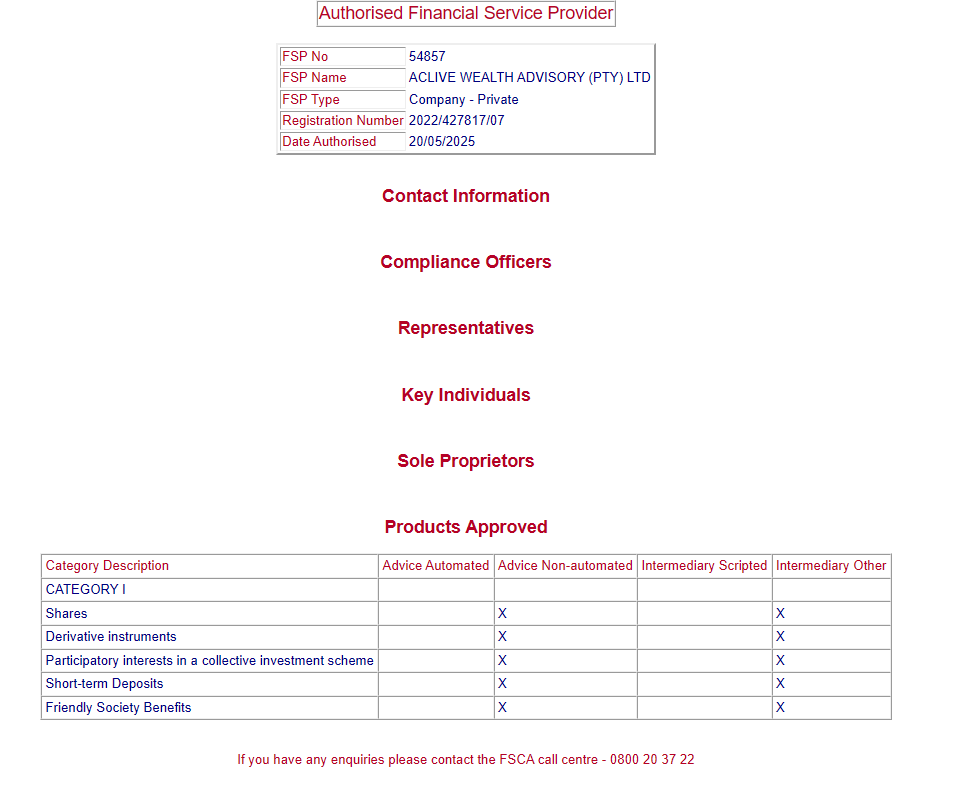
The “Products Approved” section is the revealing part. The company holds a Category I license, and every product listed is ticked under only two columns: Advice (Non-automated) and Intermediary (Other).
Category I is the entry-level tier. It permits a firm to advise clients and act as an intermediary — not to issue products, make markets, or hold client positions as counterparty. The Client Agreement confirms exactly that, naming Intrepot as the actual product supplier — though it gives the company two different names in two different sections, one of them registered in the Comoros. The license is genuine; it simply authorizes something other than what most visitors will assume.
Worse, any firm issuing OTC derivatives in South Africa must register separately as an Over-the-Counter Derivative Provider. We found no ODP registration here. That leaves three gaps:
- The entity you contract with is licensed to introduce, not to execute.
- Intrepot Ltd, which issues the CFDs, is not covered by FSP 54857 at all.
- No regulator has confirmed who supervises that supplier or how it holds money in client accounts.
Why an FSCA license alone is a warning sign:
- No investor compensation fund. The FCA backs clients up to £85,000, CySEC up to €20,000. South Africa offers nothing equivalent.
- No leverage cap. ESMA limits retail forex to 1:30; here it runs to 1:200.
- No mandatory negative balance protection or best-execution reporting comparable to European standards.
- Category I licenses are easy to obtain and routinely resold as ready-made packages.
Domain Age vs Corporate Legend: How Long Has CIFMarkets Really Existed?
We ran the domain through WHOIS to compare the company’s positioning with its verifiable age. The result is straightforward, and the screenshot below speaks for itself. Any honest cifmarkets.com review has to start from that registration date rather than from the marketing copy.
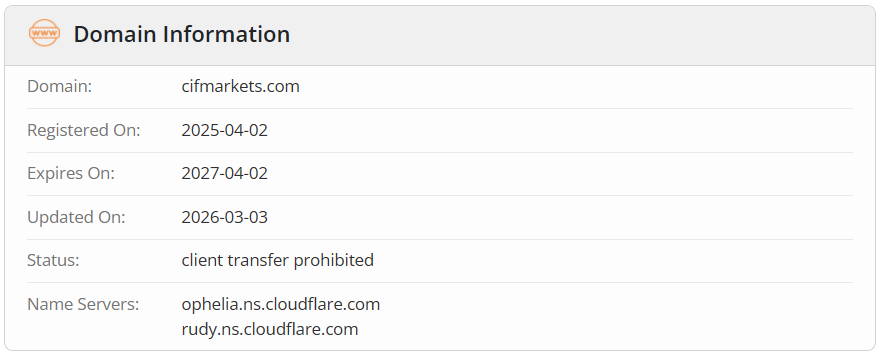
Three details stand out:
- Registered on 02/04/2025. The brand has existed publicly for barely a year. There is no earlier archived version of the site, no client base built over time, and no record of how the platform behaved during any significant market event.
- Expires on 02/04/2027. A two-year registration is the minimum commitment a domain owner can make. Established brokers routinely register their domains five to ten years ahead — it costs almost nothing and signals long-term intent. A short horizon signals the opposite.
- Cloudflare nameservers. The real hosting provider, server location, and technical fingerprint are hidden behind a proxy. This is common enough to be unremarkable on its own, but it does prevent anyone from checking whether the same infrastructure serves other brands run by the same operators.
CIFMarkets never states a founding year, which is unusual — most brokers advertise their history prominently. In this case, there is nothing to advertise. The company was authorized on 20/05/2025, seven weeks after the domain went live, meaning the entire operational history of this brand fits inside a single year.
Trading Conditions and Risk: What The Broker Publishes, and What It Quietly Leaves Out
The homepage promises “no hidden fees” and pricing “shown upfront.” The documents say otherwise. Three account tiers — Silver, Gold, Platinum — carry identical published terms: leverage up to 1:200, a 5% stop-out, and a 0.01 minimum lot. The only stated difference is a spread discount of up to 50% or 75% off Silver. Off what? No base spread is published, nor are commission, swap rate, or minimum deposit per tier — the contract specifications exist only as a separate download buried in the Legal center, never on the pages where the accounts are sold. The Client Agreement confirms the omission is deliberate: spreads on the site are called indicative, and the real figure can be confirmed only inside the platform — after you register, verify, and fund an account.
The fees that do exist appear only in the PDFs:
- 3% plus 0.25 per deposit, on top of what you send.
- A 50 EUR/USD/GBP fee for reviewing your application — a charge almost unheard of among licensed brokers.
- A minimum 50 EUR withdrawal fee, or higher at the company’s discretion.
- A 10% penalty on deposited funds if it decides you profited from price latency.
On the $250 minimum, the application fee plus one withdrawal takes forty percent before a trade is placed.
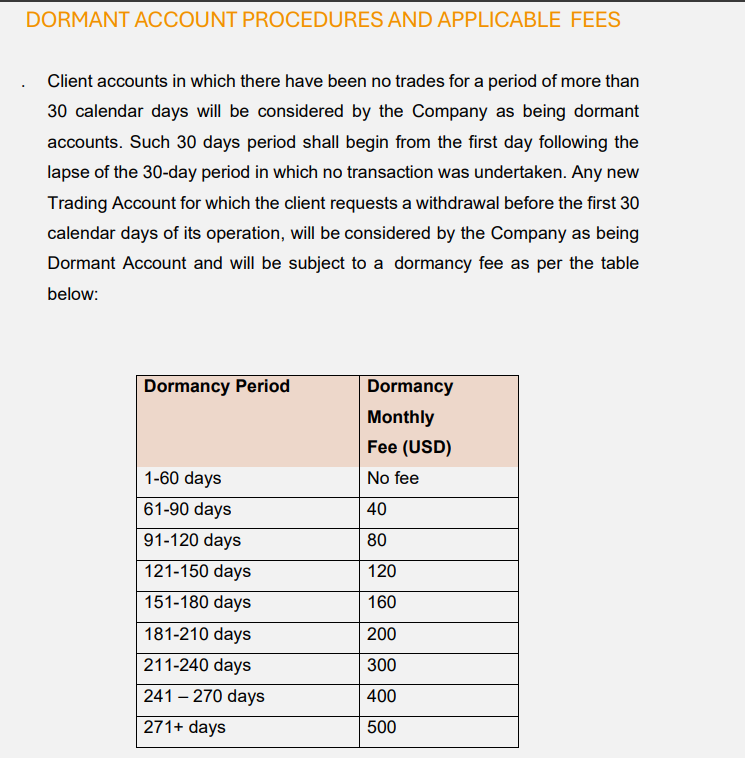
Then the inactivity trap. Accounts go dormant after 30 days without trades, where most brokers allow six to twelve months — and any new account requesting a withdrawal within its first 30 days is also reclassified as dormant. Deposit, reconsider, ask for your money back, and the account is relabeled automatically. Charges climb from $40 to $500 monthly and are deducted before any withdrawal is approved.
The counterparty question is equally murky. The firm calls itself an intermediary in one clause and “a regulated STP broker” in another, running a white-label platform whose supplier the definitions identify as Intrepot Investments Ltd, registered in the Comoros under an MISA license. Whatever a South African FSP number implies, the entity holding the risk sits offshore under one of the cheapest licenses available.
A footer risk warning exists, noting you may lose more than your deposit — quiet confirmation that negative balance protection doesn’t. What’s absent is the disclosure regulated brokers across Europe, the UK, and Australia must publish: the percentage of retail accounts losing money, typically 65% to 85%. For a platform courting beginners, omitting the one statistic most likely to give a beginner pause is a choice.
Deposits and Withdrawals: Easy In, Engineered to Be Hard Out
The CIFMarkets website has no funding page at all — just a footer strip of six card and wallet logos with no limits, no timeframes, and no minimums attached. The terms sit in a separate PDF inside a Legal center that opens with the words “transparency comes first”. And the money never reaches the broker you signed with: two same-brand paying agents collect it, ACLIVE ADVISORY (UK) LTD, which holds no FCA authorization, and ACLIVE ADVISORY (CY) LTD in Limassol, which is not CySEC-regulated. They fund a South African firm, for contracts supplied by an entity registered in the Comoros. One deposit, four jurisdictions.
Getting money out is engineered to be harder than putting it in. Deposits cost 3% plus 0.25, with conversion and bank charges deducted before crediting; withdrawals start at EUR 50 and rise at the company’s discretion. Funds return only by the same method to the same remitter, only if margin stays above 100%, and only after documents the firm can keep requesting — with the right to cancel the request and push the money back into the trading account.
A chargeback, meanwhile, is treated as an attack: it triggers an administrative fee, force-closure of open positions, possible seizure of any profits, and account termination, “final and non-negotiable”. Since registration fails from every country tested, none of this can be verified against a live cashier — these are the promises, not the practice.
Recommendations for Investors
An FSCA license covers South Africa — a country the client agreement itself lists as restricted — and gives clients abroad no standing. The regulator can fine or delicense the firm, but that returns nobody’s money, and South Africa has no compensation fund comparable to the UK’s FSCS or Cyprus’ ICF. Your actual counterparty sits in the Comoros. So: don’t fund an account here in the first place. If you already have, request a withdrawal in writing, keep every record, and check whether your card’s chargeback window is still open — typically 120 days. Never pay anything to release your funds; demands for “taxes” or “insurance deposits” before a withdrawal are extraction, not procedure. File an FSCA complaint regardless, and if a phone call brought you in, say so.
Marketing Claims and Revealed Reality
The people who worked on the review
Each Broker Expert Audit review is based on publicly available evidence, including the broker’s website and legal disclosures, regulatory registers and official warnings, corporate and domain information, trading conditions, payment policies, and relevant user reports. Our writers investigate the available evidence, while editors fact-check key claims, verify sources, and ensure that risks and uncertainties are explained clearly. Read our full Methodology of Our Reviews.
Katherine Mercer is a financial editor and fact-checker with over a decade of experience handling brokerage claims and regulatory information. With a background in economics and financial compliance, she verifies the accuracy, consistency, and risk disclosure of all investigative articles. Her purpose is to ensure that each review is accurate, sourced reliably, and technically sound.
More about me →
this is maximum risk… I don’t know how anyone could trust their money to a pseudo-broker like this… there are plenty of damning reviews of cifmarkets online… before opening an account, I advise reading them… I don’t think you can trade here safely and profitably… that’s the opinion of an experienced trader…