

Intrepot is an offshore CFD broker that sells three account tiers priced as percentage discounts off a base spread it has never published. No commission schedule, swap rate, or contract specification appears anywhere on the site. We went looking for the numbers behind the tiers and explain below what we found instead.
- Intrepot: Regulatory and Operational Risk Profile
- A License That Verifies — From an Authority the Central Bank Calls Fictitious
- What a Company Says About Its Own Age, and What the Domain Says
- What the Intrepot Trading Platform Costs You, and Why Nobody Can Tell
- Eleven Payment Logos and No Way to Use Any of Them
- Recommendations for Investors
- Marketing Claims and Revealed Reality
Intrepot: Regulatory and Operational Risk Profile
| Target Brand & Domain | Intrepot (intrepot.com) |
| Risk Index | High risk |
| Legal Entity & Stated Jurisdiction | Intrepot Investments Ltd (Union of Comoros) |
| Regulatory Status & License | Verified (MISA, BFX2025155) |
| Regulatory Blacklists | Not listed |
| Domain Age vs Claimed History | Created: 24/12/2025 (Claimed: No history) |
| Trading Platform Software | Custom WebTrader |
| Deposit Methods & Chargeback | Closed Client Area (Chargeback unknown) |
A License That Verifies — From an Authority the Central Bank Calls Fictitious
Before any conclusions, we check the paperwork. The footer of the site names Intrepot Investments Ltd, registered in the Union of Comoros under number HV00126489, holding license BFX2025155 from the Mwali International Services Authority, at Bonovo Road, Fomboni, Island of Mohéli.
We ran the number throughMISA’s own register of authorized brokerage companies, and it returns a live record: status Active, license issued December 30, 2025, expiring December 30, 2026, with intrepot.com listed as the corresponding website. Credit where it is due — the company is not inventing a license number, and the entity it names is the entity in the register. That already puts it ahead of a large share of the sites we examine, and it is the reason our Intrepot review does not open with the word “fake.”
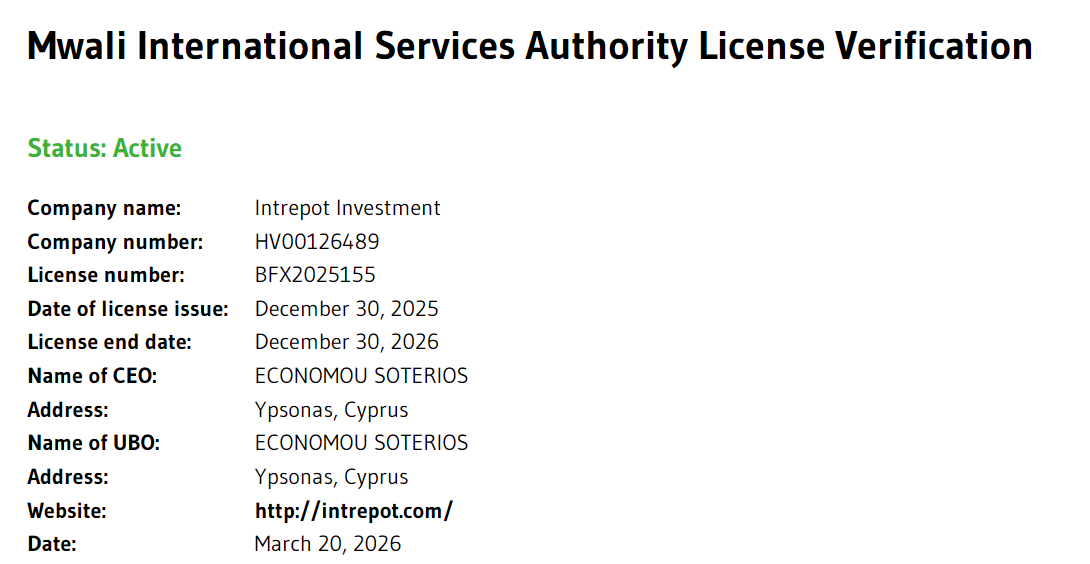
The problem is not the document. The problem is who issued it. Mwali is one of three islands making up the Union of Comoros, alongside Ngazidja and Ndzwani (Anjouan). It is an island administration, not a sovereign state, and it has no constitutional power to license financial firms. The country’s actual financial regulator, the Banque Centrale des Comores, has said so publicly and repeatedly. In its communiqué on the illegal exercise of offshore banking activities, the central bank lists the following among what it calls fictitious structures pretending to issue financial licenses in the Union of Comoros:
- Mwali International Services Authority (M.I.S.A.), mwaliregistrar.com.
- Anjouan Offshore Finance Authority, anjouanregister.com.
- Anjouan Corporate Services.
- Comoros Services Ltd.
- Comoros International Banking Authority (CIBA).
What does this mean for a trader:
- No compensation fund. If the company stops paying, there is no scheme behind it — unlike the FSCS in the UK or the ICF in Cyprus.
- No capital adequacy supervision. Nobody audits whether client money is segregated, or whether it exists.
- No conduct oversight. No regulator reviews spreads, execution quality, or marketing claims.
- No escalation route. MISA does not adjudicate client complaints, and the client agreement names no court, arbitrator, or ombudsman anywhere.
- No enforcement, by design. An authority the sovereign central bank describes as fictitious cannot revoke anything that matters.
A MISA license is a subscription, not a supervision regime. It is renewed annually against a fee, and in this case both the license and the domain registration expire within six days of each other in December 2026 — which is the practical lifespan of the entire legal construction.
So yes, Intrepot holds a license. It just carries no obligations the company can be held to and no rights the client can exercise — which, in every way that matters at the moment something goes wrong, is indistinguishable from holding none at all.
What a Company Says About Its Own Age, and What the Domain Says
Most brokers open their About page with a founding year. Here there is none — no “since”, no milestones, no team, and no office beyond the registered address in the Comoros. The company makes no claim about its age whatsoever. That is not a lie, but it leaves a gap a reader has to fill, so we filled it with the domain record.
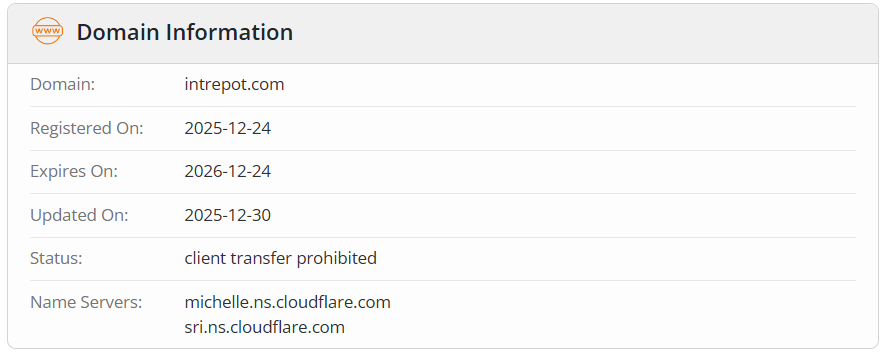
For this intrepot.com review, WHOIS shows the domain registered on December 24, 2025 — roughly eight months old at the time of our checks — and registered for one year only, expiring December 24, 2026. The license runs to December 30, 2026. The domain and the license lapse within six days of each other, and the whole legal structure resets in a single week this December. The gap at the other end is just as short: six days between the domain going live and the brokerage license being issued.
Eight months is not evidence of fraud. It is the absence of evidence of anything — no withdrawal history, and no proof the platform performs under stress. A brokerage earns trust by surviving conditions, and this one has not been through any.
What the Intrepot Trading Platform Costs You, and Why Nobody Can Tell
The Trading Accounts page offers Silver, Gold, and Platinum. All three carry identical leverage of up to 1:200, an identical 5% stop-out, and an identical 0.01 minimum lot. The only difference is a spread discount of up to 50% or 75%, and a swap discount of 40% or 60% — percentages off a base figure the company has never published anywhere.
There is no spread table, no commission schedule, no swap rates, and no contract specifications on the site. The minimum deposit is absent from the pricing page entirely and surfaces only in the support FAQ, where it appears as $250; the client agreement states €250. Set that against the homepage promise that “spreads, commissions, and funding costs are fully visible from the start”, then against the agreement’s own admission that any spreads shown on the website are “indicative only”. A trader cannot calculate the cost of a single position before funding an account.
Execution is described three different ways in one document. Intrepot acts “as an agent”, transmitting orders to liquidity providers. Elsewhere it executes “as a regulated STP broker.” Elsewhere still, it may route trades through an intermediate broker “who may also be an affiliate of the Company,” and accepts no liability for that broker’s conduct. No liquidity provider or execution venue is named anywhere.
The risk warning exists but does not do the one job that matters: it discloses no percentage of losing retail accounts. Every FCA-, CySEC-, or ASIC-authorized firm publishes that figure, and it typically lands between 65% and 85%. Here there is none — and instead a statement that clients may lose more than they deposit, meaning no negative balance protection. The agreement goes further, acknowledging that reversed deposits “may result in a negative balance.”
Then come the clauses that decide what happens when something goes wrong:
- Dormancy is weaponized. An account with no trades for 30 days is dormant. So is any new account requesting a withdrawal inside its first 30 days. Fees run from $30 monthly to $500, and are charged before any withdrawal is approved.
- Entry fees. 3% plus a handling charge on every deposit, plus a €50 “examination of application fee” on new applications.
- Trading style as breach. Scalping and sniping void profits. Latency arbitrage triggers a penalty of 10% of deposited funds. Canceling more than one trade per ten executed counts as abuse.
- Liability disclaimed wholesale. The company is not answerable for platform failures, execution delays, slippage, reliance on stop-loss orders, or acts of any third party — and stop-outs apply even to positions carrying a guaranteed stop-loss.
- A bonus regime referenced but never published. The agreement binds clients to a Bonus Agreement “as published on the Company’s website.” No such document exists there, so the wagering conditions attached to any bonus a manager offers are unknowable in advance.

The pattern is consistent: every number a client would use to assess cost is withheld, and every clause Intrepot would use to withhold money is spelled out.
Eleven Payment Logos and No Way to Use Any of Them
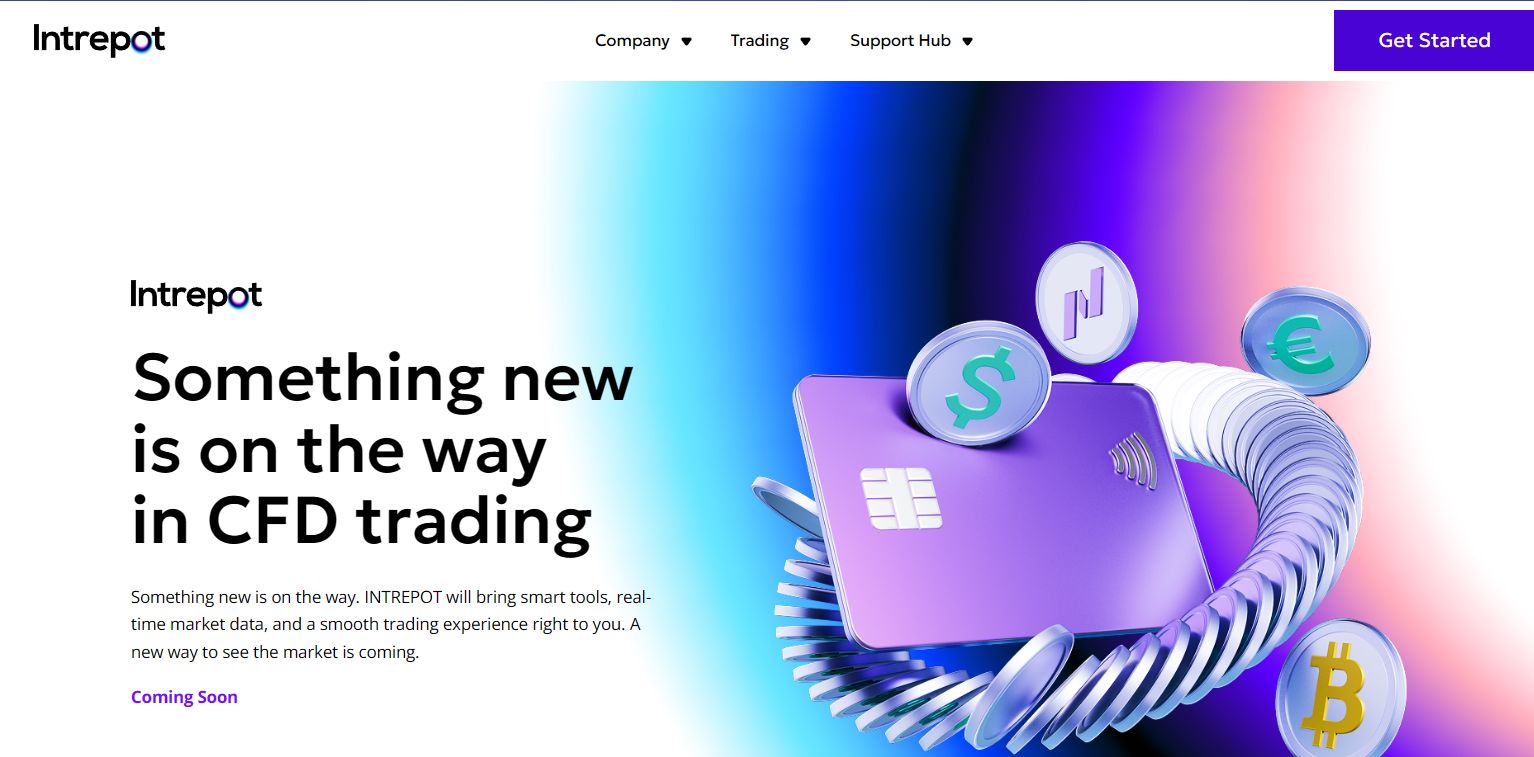
We tried to open an account. Clicking Get Started produces no registration form — only a splash page reading “Something new is on the way in CFD trading” and, beneath it, Coming Soon.
That reframes the rest. There is no client area, no deposit page, and no way for anyone outside the company to confirm which payment methods work or that a withdrawal has ever been processed. A firm that is licensed, contractually binding, and charging a documented fee schedule still cannot accept a client.
Nobody is named as the payment processor. The footer shows eleven logos — Visa, Mastercard, PayPal, Skrill, Neteller, AstroPay, and others — with no limits, timeframes, or per-method fees, and no PSP or paying agent identified anywhere in the agreement. The FAQ adds bank transfers, which appear in none of the logos.
The costs, by contrast, are specified precisely: 3% plus a handling charge on every deposit, a €50 fee simply to review an application, and dormancy charges from $30 to $500 monthly — levied before any withdrawal is approved, and triggered by requesting one within an account’s first 30 days. Withdrawals are same-method, same-remitter only, and the processing time is stated in three incompatible ways in one document.
Chargebacks carry the harshest clause: a dispute of any kind lets the company force-close positions, terminate the account, and seize “any profits or revenues”, with its decision “final and non-negotiable”.
The card logos matter for one reason — cards are the only funding route carrying chargeback rights at all. Crypto and P2P transfers have none. With the client area sealed, nobody can confirm which of these a depositor would actually be offered once it opens.
Recommendations for Investors
The MISA license protects nobody in any jurisdiction: no compensation fund, no capital supervision, no complaints body, and no regulator with the standing to force a payout. Anyone who deposits does so entirely at their own risk, under Comorian law, with no court or arbitrator named in the contract. If you have already sent money, request a full withdrawal in writing, keep every receipt, and if you paid by card, ask your issuer about a chargeback. For anyone still choosing a broker, pick one regulated by the FCA, CySEC, or ASIC, where segregated funds and negative balance protection are legal requirements rather than marketing copy.
Marketing Claims and Revealed Reality
The people who worked on the review
Each Broker Expert Audit review is based on publicly available evidence, including the broker’s website and legal disclosures, regulatory registers and official warnings, corporate and domain information, trading conditions, payment policies, and relevant user reports. Our writers investigate the available evidence, while editors fact-check key claims, verify sources, and ensure that risks and uncertainties are explained clearly. Read our full Methodology of Our Reviews.
Katherine Mercer is a financial editor and fact-checker with over a decade of experience handling brokerage claims and regulatory information. With a background in economics and financial compliance, she verifies the accuracy, consistency, and risk disclosure of all investigative articles. Her purpose is to ensure that each review is accurate, sourced reliably, and technically sound.
More about me →