

Two offshore authorizations look more solid than one, and that is precisely the effect they are meant to produce. Neither the Vanuatu nor the Mauritian license held by Gerchik & Co covers execution quality, negative balance protection, or repayment if the firm fails. We looked at what each one really permits.
- Gerchik & Co: Regulatory and Operational Risk Profile
- Legal Reality: Two Offshore Entities and One Contract You Actually Sign
- Track Record Analysis: What the Domain Records Actually Show
- Conflict of Interest by Design: How Gerchik & Co Rewards Turnover, Not Results
- Trading Conditions at Gerchik & Co: Where the Real Cost Sits
- Deposits, Withdrawals, and the Exit That Is Currently Closed
- Recommendations for Investors
- Marketing Claims and Revealed Reality
Gerchik & Co: Regulatory and Operational Risk Profile
| Target Brand & Domain | Gerchik & Co (gerchik.co) |
| Risk Index | High risk |
| Legal Entity & Stated Jurisdiction | Gerchik & Co Limited (Vanuatu), GERCHIK & CO. MU LIMITED (Mauritius) |
| Regulatory Status & License | Verified |
| Regulatory Blacklists | Not listed |
| Domain Age vs Claimed History | Created: 07/01/2015 (Claimed: since 2015) |
| Trading Platform Software | Verified MetaTrader 4/5 |
| Deposit Methods & Chargeback | Bank cards/wire (Chargeback possible), crypto (No chargeback) |
Legal Reality: Two Offshore Entities and One Contract You Actually Sign
We started where every audit should start — with the register rather than the marketing page. The Vanuatu Financial Services Commission publishes its Financial Dealers Licensee List as an open PDF, and the entry is there:you can verify it yourself, line 24, company number 40512, licensee Gerchik & Co Limited, status Active. So the first two parameters match the website exactly, and to be fair, the company also publishes certificate images in its legal section instead of hiding them behind vague wording. That is more than most offshore operators bother to do.
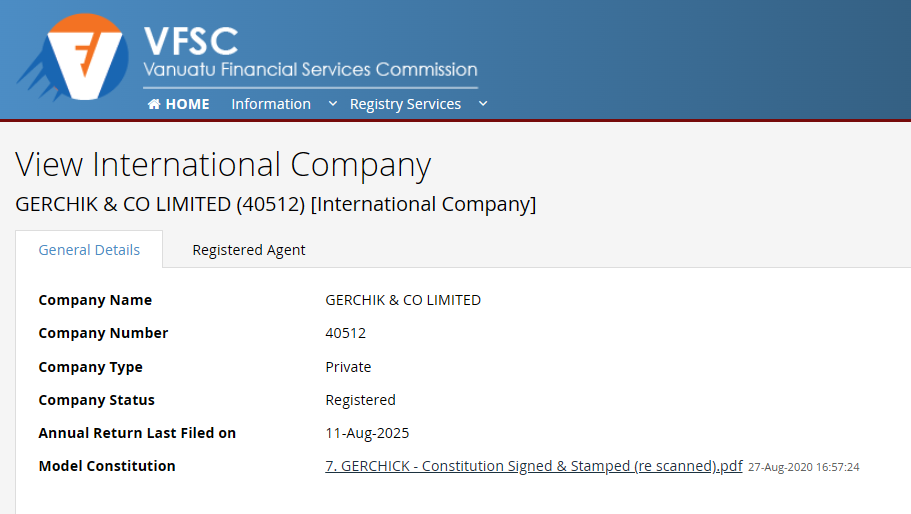
The Vanuatu list contains no website column at all, and the Mauritian register works the same way — neither supervisor states which domain belongs to which licensee. In practice, this means nobody but the company itself confirms that gerchik.co is operated by the licensed entity, which is precisely the loophole that clone sites exploit across this jurisdiction. With an FCA or ASIC entry, you would see the trading names and web addresses listed next to the firm; here you simply have to take the operator’s word.
The Mauritian side adds a second entity rather than a second layer of safety. GERCHIK & CO. MU LIMITED, company number C177547, holds an Investment Dealer (full service excluding underwriting) license No. GB20025814 from theFinancial Services Commission — a real authorization, issued by a real regulator, and completely irrelevant to the person opening an account through the main website. The footer names the Vanuatu company as the contracting party, meaning that if funds go missing, the claim is filed in Port Vila, not Port Louis and certainly not in London, despite the UK address of the “financial services provider” printed alongside.
None of this makes the operation illegal. It makes the licenses narrow: neither jurisdiction runs an investor compensation fund, neither audits execution quality, and neither publishes the domain that would tie the paperwork to the platform you are actually depositing into.
Track Record Analysis: What the Domain Records Actually Show
Longevity claims are easy to fake and easy to check, so we ran the domain records first. The result surprised us in a good way: WHOIS puts creation at 7 January 2015, registration is paid through to 2026, and the registrant is not hidden behind a privacy shield — it appears openly as the Vanuatu company, with a Port Vila address.
An old registration date, though, is not ten years of operation:
- The Wayback Machine holds 236 captures of this address, and the first of them dates to 8 August 2018. Between the 2015 registration and that summer, the domain left no archived trace whatsoever.
- The Vanuatu entity was incorporated three weeks after that first snapshot, on 30 August 2018, and the license certificate published in the legal section was sealed in Port Vila at the end of 2022.
- The footer nonetheless claims a continuous run from 2015, merging three different things — the age of a parked address, the age of a personal brand, and the age of the authorized business.
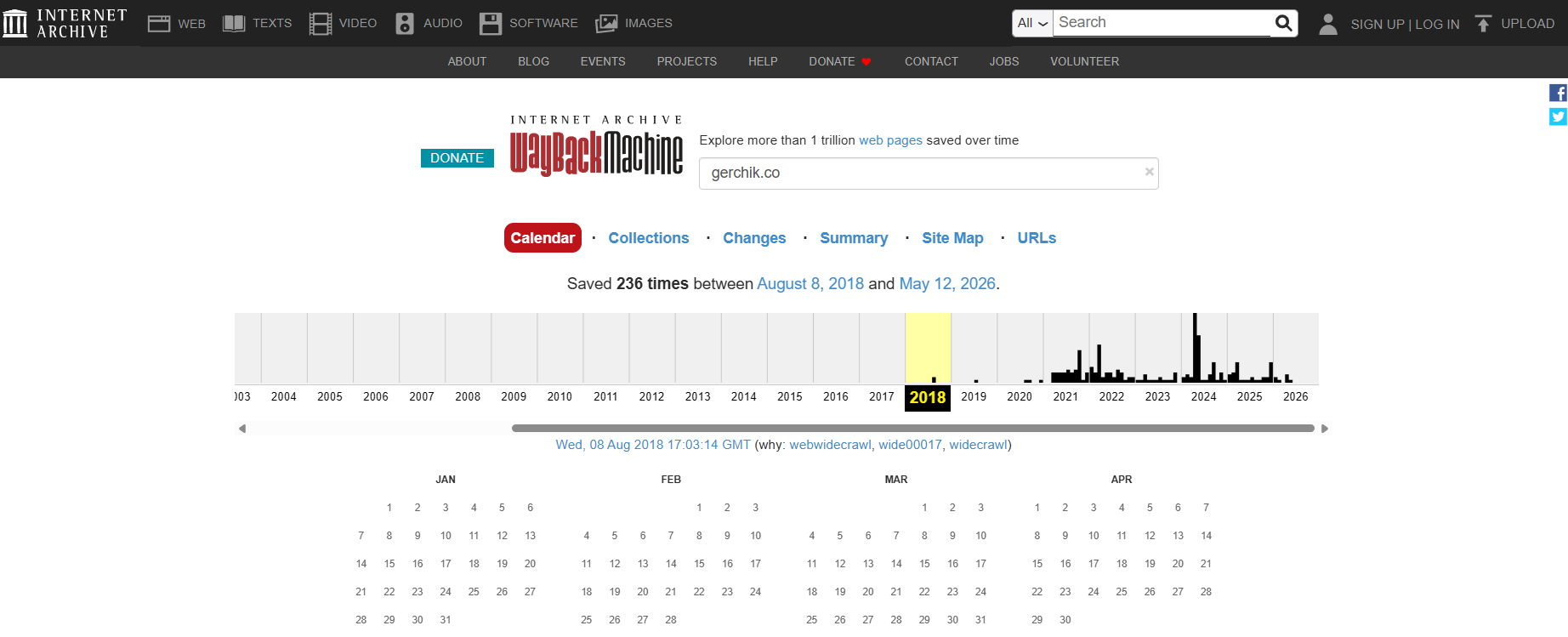
The honest version of the history behind our gerchik.co review reads: a name in the market since 2015, a live website and a company since 2018. Anyone assuming a decade of supervised operation is off by three years.
That first snapshot also tells us what Gerchik & Co was built to sell. The August 2018 homepage leads not with spreads or execution speed but with a free course called Trading from Scratch, delivered by a bot mentor — education was the front door long before brokerage was, and the balance between the two has not really changed since.
The wider footprint deserves credit — Telegram, YouTube, TikTok, Discord, a separate stock portal, an affiliate subdomain. A brand this distributed is not disappearing overnight, which shifts the risk: the threat is not a sudden exit, it is what happens to one account inside a long-lived offshore structure.
Conflict of Interest by Design: How Gerchik & Co Rewards Turnover, Not Results
We looked for the usual boiler-room markers and, in fairness, did not find them. There are no fixed-return investment plans, no multi-level referral tree, and no promises of guaranteed profit — the affiliate scheme is a single-tier revenue share paying up to 40% of the commission a referred client generates, with no entry deposit and withdrawals from one dollar. Reputable brokers run comparable programs. The problem is not the structure but what it rewards.
Every payout in Gerchik & Co is tied to client turnover, never to client results. A partner earns when the person they brought in trades often, regardless of whether that person is up or down. The company earns the same way. Nobody in the chain has a financial reason to tell a beginner to slow down, and that is the quiet mechanism behind the endless push toward more lots, bigger deposits, and faster decisions.
The trust-management service deserves a closer look:
- Losses and profits are shared unequally. A TIMA account can end a period in profit for the manager and still be a losing position for the investor, because the manager’s fee comes off the gains while the drawdown belongs entirely to the client.
- The agent program advertises income, offering 15% of a manager’s monthly profit and floating a figure of $1,500 a month for those who bring in large investors. Presenting expected earnings before presenting expected risk is a marketing choice.
- Analytical tools unlock by deposit size, with the trading journal opening at $1,000 and the volume indicator at $2,000, so the instruments sold as risk protection are themselves a reason to top up.
Then there is the deposit bonus of up to $2,000. Bonus money in offshore CFD trading almost always carries turnover conditions that must be met before withdrawal, which converts a gift into a lock on the account — read that clause before accepting anything.
One more claim about Gerchik & Co worth deflating. Membership of the Financial Commission is presented across the site as investor protection with compensation of €20,000 per complaint. FinaCom is a private dispute-resolution body funded by the brokers who join it, not a regulator: it cannot fine anyone, cannot revoke a license, and its fund is capped per claim. Useful, occasionally effective, but it is arbitration paid for by one side of the argument.
Trading Conditions at Gerchik & Co: Where the Real Cost Sits
The front page promises spreads from 0 pips on a commission-free ZERO account, yet the table underneath splits that promise between two products. The 0.0 spread belongs to Premium, which costs $3,000 and $8 per lot, while the $10 entry account carries a markup formula few visitors will parse — ten divided by the pip value of the last digit, added to the ask and subtracted from the bid, plus an extra point when the result is odd.
Leverage shows where the offshore license matters:
- Up to 1:500, easing to 1:100 only above a $100,000 balance, against 1:30 for retail clients under FCA, ESMA and ASIC rules.
- Stop-out at 50%, margin call at 100%, and no mention of negative balance protection anywhere.
- Bonuses of up to $2,000 on top-ups — banned for retail clients across the EU, UK, and Australia because they inflate margin and entangle withdrawals.
Gerchik & Co promises STP and interbank execution; the specification says Market execution and names no liquidity provider. The one external check is aVerifyMyTrade certification on 5,000 trades a month — a real audit, though paid for and run on a sample the company submits itself.
The footer does carry a risk statement, honest about losing invested funds, and it stops there. What it never gives is the share of clients who actually lose money, the figure that regulated firms must display — usually between 65% and 85%.
Deposits, Withdrawals, and the Exit That Is Currently Closed
The funding page opens with a reassuring line — the broker charges nothing, every fee belongs to the payment system. Then comes a column headed “your expenses”: 2.8% on Visa and Mastercard deposits, 0.75% on crypto, €20 flat on outgoing SEPA. A $1,000 card deposit lands as $972 before a single trade, where IC Markets or Pepperstone would absorb that cost entirely.
The small print matters more:
- Card withdrawals are suspended for what the notes call temporary technical issues, while card deposits stay open.
- USD bank transfers are unavailable in both directions, leaving euro SEPA as the only fiat exit.
- Money may leave only through the channel it arrived by.
- Requests are handled on weekdays between 9:00 and 18:00.
Together, those rules funnel a card depositor toward crypto — an irreversible transfer with no chargeback rights.
No processing entity is named in the legal section, yet the page recommendsSharPay as the cheapest route. That firm sells white-label payment infrastructure for industries banks avoid — forex, iGaming, crypto — on the promise that payments look native and the customer never sees a third-party processor. Whoever holds your money mid-transfer, you will not learn it from this site.
The footer names one more participant without explaining what it does. Under the heading Financial Services Provider, beside the Visa and Mastercard logos, sitsJ.B. Finance LLP — a British partnership, number OC399405, incorporated in April 2015 and still active. Companies House shows no declared business activity for it and accounts filed under total exemption, the format that used by entities with nothing substantial to report, and no FCA authorization is claimed for it anywhere. A London name beside the card logos suggests a British firm handling your payment; the register suggests a partnership with no stated line of business at all.
Recommendations for Investors
The Vanuatu license protects you inside Vanuatu and nowhere else — the VFSC has no mandate over disputes involving clients in Europe or Central Asia, and it runs no compensation fund of any kind. Your realistic remedy is the Financial Commission, capped at €20,000 per complaint and funded by member brokers rather than by a state. So keep deposits at a size you can afford to lose entirely, avoid card funding while withdrawals through that channel remain closed, and test a small withdrawal before adding serious money. Treat Gerchik & Co as an offshore account with a recognizable name attached, not as a regulated one.
Marketing Claims and Revealed Reality
The people who worked on the review
Each Broker Expert Audit review is based on publicly available evidence, including the broker’s website and legal disclosures, regulatory registers and official warnings, corporate and domain information, trading conditions, payment policies, and relevant user reports. Our writers investigate the available evidence, while editors fact-check key claims, verify sources, and ensure that risks and uncertainties are explained clearly. Read our full Methodology of Our Reviews.
Katherine Mercer is a financial editor and fact-checker with over a decade of experience handling brokerage claims and regulatory information. With a background in economics and financial compliance, she verifies the accuracy, consistency, and risk disclosure of all investigative articles. Her purpose is to ensure that each review is accurate, sourced reliably, and technically sound.
More about me →
I traded with Gerchik & Co a long time ago, because I used to watch the educational videos of this company’s founder. I thought he was a serious person, but this broker’s treatment of me made me change my opinion. I’ll briefly list the problems I ran into: slow tech support responses, constantly widening spreads, terrible terminal performance, and problems with withdrawals. I won’t go into the details, it’s painful for me to recall this negative experience. I just want to warn inexperienced traders — you’re better off not trading here.