

GBP Markets is a broker with a short operating history that claims to be licensed in an suspicious offshore jurisdiction. In this article, we examine the validity of these claims and the potential pitfalls awaiting clients.
- GBP Markets: Regulatory and Operational Risk Profile
- GBP Markets: Is the Registration Really Legitimate?
- Does the Gbpmarkets.com Domain Age Match the Broker’s Legal History?
- Guaranteed Returns Instead of Real Brokerage
- Trading Conditions: What GBP Markets Doesn’t Tell Clients
- Depositing and Withdrawing Funds: Terms That Work Against the Client
- Recommendations for Investors
- Marketing Claims and Revealed Reality
GBP Markets: Regulatory and Operational Risk Profile
| Target Brand & Domain | GBP Markets (gbpmarkets.com) |
| Risk Index | High risk |
| Legal Entity & Stated Jurisdiction | VeloFlow Capital Ltd |
| Regulatory Status & License | Unverified |
| Regulatory Blacklists | Not listed |
| Domain Age vs Claimed History | Created 20/02/2026 (Claimed: No history) |
| Trading Platform Software | Unknown |
| Deposit Methods & Chargeback | Bank wire / Crypto (Chargeback is prohibited) |
GBP Markets: Is the Registration Really Legitimate?
At first glance, GBP Markets’ legal position appears quite convincing. The company claims to operate under the management of VeloFlow Capital Ltd, registered in the Union of the Comoros, listing registration number HV00426493 and license BFX2026028, issued by MISA (Mwali International Services Authority).
However, a check of MISA’s official registry reveals a more complex situation. Indeed, VeloFlow Capital Ltd is listed in the regulator’s database. According to the registry, the company was incorporated on April 9, 2026, and holds a license with the specified number. That’s where the similarities end.
The main problem is that the MISA licensee card lists a completely different official website veloflowcapital.com, not gbpmarkets.com. In fact, for licensed financial institutions, the official domain is one of the key identifiers, allowing clients to verify that they are dealing with the actual company that has been registered and licensed.

A further review of VeloFlow Capital’s website only reinforces these doubts. The company positions itself not as a broker, but as a provider of marketing, operational, and infrastructure services for financial market participants. The website states that the organization provides marketing support, back-office solutions, and liquidity services to other financial sector companies. However, the GBP Markets brand is nowhere mentioned, and there is no information about the brokerage platform, trading accounts, or retail client services.
This discrepancy is hardly coincidental. If VeloFlow Capital truly operates GBP Markets, it would be logical to expect at least a minimal mention of the brand on the corporate website or a listing of the corresponding domain in the MISA registry. Instead, we see two seemingly unrelated online platforms.
The MISA license itself should also be kept in mind. This offshore regulator has long been criticized by financial market participants for its extremely lax requirements for licensees and the lack of effective oversight of their activities. Even if the license does indeed belong to VeloFlow Capital, it alone does not provide any level of protection for investors.
Does the Gbpmarkets.com Domain Age Match the Broker’s Legal History?
As we noted in the previous section, VeloFlow Capital Ltd, referenced by GBP Markets, was registered and received its MISA license only on April 9, 2026. However, a WHOIS check reveals that the gbpmarkets.com domain was created earlier, in February 2026.
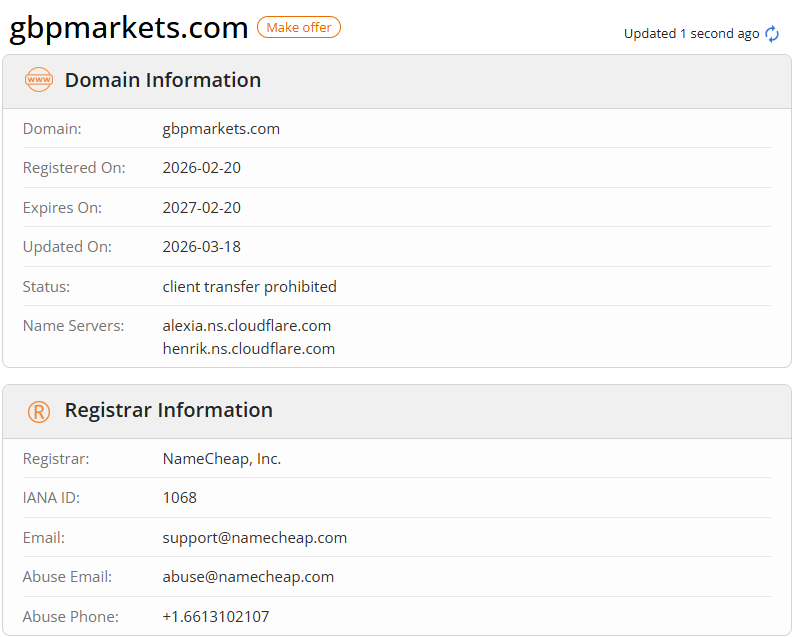
It should be noted that companies sometimes reserve domain names even before completing the legal entity registration. However, in this case, we are talking about a broker that claims to be engaged in licensed financial activities. It would be logical to expect that the legal entity would be established first, then the license would be obtained, and only then would the trading platform be launched. However, here the sequence is strangely reversed.
The overall age of the project raises even more questions. Even if we accept the company’s official version, it appears that the broker has only been in existence for a few months. For a financial institution that clients must entrust with significant sums, such a long period is hardly encouraging.
Experience shows that most truly reliable brokers take years to build their reputation. Over several years of operation, a company’s development history, publications in specialized media, client reviews, performance statistics, and regulatory responses to potential violations are established. A long history allows investors to assess the intermediary’s stability and its handling of crises.
In general, the lack of a long-standing reputation significantly increases the level of risk.
Guaranteed Returns Instead of Real Brokerage
Even a cursory examination of the GBP Markets website reveals one of the most dangerous signs of a fraudulent project: the promise of a guaranteed return. The company offers clients the “Earn 5.4%” program, claiming that users can earn 5.4% monthly on their trading account balance, including funds in open positions.
Such claims are extremely suspicious. Firstly, a brokerage company should not promise a fixed investment return. Financial market returns, by definition, cannot be guaranteed, and licensed brokers are not supposed to use such marketing hype. On the contrary, regulators require clients to be constantly reminded of the high risks of CFD trading and warn that most retail investors lose money.
Secondly, the promised 5.4% per month equates to approximately 90% per annum with compounded interest. This return is many times higher than the rates offered by banking products. Please note that this is simply a marketing ploy, as the company doesn’t explain the mechanisms by which this income is generated, who pays the interest, or the actual risks borne by the investor.
The description of the program itself is equally revealing. Instead of clear legal terms, it uses phrases like “may qualify,” “defined program terms,” and “structured and licensed trading environment.” There are virtually no specific rules for calculating interest, a list of exceptions, program termination procedures, or payment guarantees on the website.
There is also a more fundamental problem. There are growing indications that GBP Markets is not a fully-fledged broker with client orders being transferred to external markets. We have already raised serious questions about the license used and the legal connection with VeloFlow Capital. Under these circumstances, the Boiler Room model seems most likely.
The essence of this scheme is simple: client trades are not sent to liquidity providers, but remain entirely within the company’s system (this is B-Book execution). The broker becomes the other party to each trade. If the client loses money, the company profits. If a trader begins to earn a stable income, their payments become direct expenses for the platform itself. This is precisely why such projects have an obvious conflict of interest.
Trading Conditions: What GBP Markets Doesn’t Tell Clients
GBP Markets offers a range of trading accounts, with differences extending beyond just the initial investment amount. The minimum threshold starts at $300 for the Intro account, rising to $1,000 for Basic, $2,500 for Plus, and $5,000 for Extra. Requirements become significantly higher for Platinum accounts: $10,000 for Advanced, $25,000 for Premium, $100,000 for Exclusive, and a substantial $250,000 for VIP.
The maximum leverage is set at 1:200 across all categories. Additional specifications include a minimum position size of 0.05 lots for the Basic account, while the VIP account requires a minimum of 1 standard lot with a minimum increment of 1. Please note that 1:200 is quite aggressive leverage, particularly given that the broker targets not only professional traders but also clients with deposits starting at just a few hundred dollars.
Spread information is provided only for accounts from the Plus level upwards. Spreads start at 1.6 pips for Plus and Extra accounts, 1.2 pips for Advanced and Premium, 1 pip for Exclusive, and 0.8 pips for VIP. However, no specific figures are given for Intro and Basic accounts. Furthermore, the use of the term “from” makes it impossible to determine the actual spreads for specific instruments or the frequency of spread widening.
The lack of comprehensive trading condition specifications raises further questions. The provided description fails to disclose exact swap rates, transaction commissions and their calculation terms, order execution models, potential requotes, maximum position sizes, and other parameters needed to assess the true cost of trading. Essentially, we are asked to select an account and deposit funds without having a clear picture of future expenses.
The system of bonuses and additional benefits also warrants special attention. Even entry-level accounts offer Welcome Bonuses, Refer-a-Friend bonuses, cashback, protected trades, and various credit-based perks. Higher-tier plans boast an even more impressive list of features: trading psychology coaching, mentoring, long-term financial planning, Platinum sessions, event invitations, and other privileges. However, these bonuses always come with specific conditions, such as mandatory trading volume requirements, which significantly impact the ability to withdraw one’s own funds.
The concept of “Protected Trades” is particularly odd. Intro and Basic accounts are promised three protected trades with $25 in credit; Extra accounts get five trades at $50 each; and Advanced accounts (and above) receive ten trades with up to $200 in credit. Yet, the broker fails to explain exactly what a “protected trade” entails, who covers potential losses, or what restrictions apply to the use of such credit. In a genuine market, there is no such thing as a protected trade. To us, this is a clear indication that a B-book model is being used.
There is another issue that is hard to overlook. While larger deposits unlock more promised benefits, the quality of disclosure regarding terms and conditions barely improves. Even a VIP client, expected to deposit $250,000, receives no comprehensive breakdown of commissions, swap rates, execution details, or other costs. It is strange to see such high deposit requirements alongside such incomplete information about how those funds will actually be handled.
In short, GBP Markets relies on a wide array of account tiers, bonuses, and additional services to create the impression of a rich selection for various client categories. But that is merely an impression. Before depositing money, a client does not receive enough information to objectively assess the true cost of trading or the limitations associated with using the bonuses.
Depositing and Withdrawing Funds: Terms That Work Against the Client
GBP Markets states that client funds intended for trading must be held in segregated bank accounts — that is, separate from the company’s own funds. However, the company reserves the right to select these institutions at its own discretion from time to time, making it impossible to verify the actual location where funds are held in advance.
The situation regarding account funding is somewhat more transparent, yet important limitations remain. GBP Markets specifies that incoming funds are credited net of fees charged by banks and any intermediaries involved in the transfer. Furthermore, the company is required to verify the sender’s identity and may return the payment if it cannot confirm that the funds originated directly from the client. In effect, the cost of bank fees is passed on to the trader.
Withdrawals are also subject to additional conditions. Clients may withdraw available funds not currently used as margin; however, the company reserves the right to reject or delay a request if it deems the submitted documentation insufficient. In such cases, the company may request additional documents, cancel the request, and return the funds to the trading account.
Withdrawal timeframes are also unimpressive. According to the agreement, request processing takes 3–7 business days, followed by up to three additional days for the funds to be credited to the client’s bank account. Consequently, even without documentation issues, the actual receipt of funds can take up to ten business days.
The provision regarding withdrawal methods is particularly noteworthy in our GBP Markets review. The company reserves the right to refuse a withdrawal via a specific payment method and suggest an alternative, requiring the client to submit a new request. The agreement does not specify the grounds for such a decision.
Bank fees also warrant special attention. The client bears all costs associated with withdrawing funds to their account. Moreover, if a bank or payment provider reverses a previously executed transaction, GBP Markets may not only cancel the corresponding deposit but also reverse subsequent transactions. This could potentially result in a negative balance on the trading account — a scenario explicitly permitted under the agreement.
However, the most concerning clause relates to chargebacks. The client expressly agrees not to initiate a chargeback, nor to dispute or reverse completed payments. Should the client attempt to do so, the company reserves the right to cease providing services, terminate the agreement, withhold payments due to the client, and seek compensation for its own losses.
A chargeback is a mechanism that, under certain circumstances, allows a client to dispute a card payment through their bank. It is highly unusual for GBP Markets to require a waiver of this right in advance while simultaneously stipulating severe consequences for attempting to dispute a transaction.
Bank transfers also raise concerns. Although the payment form initially appears standard, the listed merchant is not GBP Markets but Kingstrade, a separate website that appears to offer questionable educational services. The broker also provides no clear schedule of payment processing or withdrawal fees, while the involvement of a third-party payment processor makes recovering funds particularly difficult in the event of a dispute.
Recommendations for Investors
GBP Markets should be approached with extreme caution; even if its MISA registration is genuine, it pertains to an offshore jurisdiction and does not offer the standard level of investor protection. This license does not provide access to the compensation funds or regulatory safeguards associated with top-tier authorities. Further concerns arise from the discrepancy between the website listed in the MISA registry and the actual GBP Markets site, as well as the project’s extremely short track record. We would not recommend depositing funds or sharing sensitive personal and financial information with this broker, as doing so appears to carry significant risk. Finally, if you have already lost money, do not trust anyone promising to recover it in exchange for an upfront fee, as this could be a recovery scam.
Marketing Claims and Revealed Reality
The people who worked on the review
Each Broker Expert Audit review is based on publicly available evidence, including the broker’s website and legal disclosures, regulatory registers and official warnings, corporate and domain information, trading conditions, payment policies, and relevant user reports. Our writers investigate the available evidence, while editors fact-check key claims, verify sources, and ensure that risks and uncertainties are explained clearly. Read our full Methodology of Our Reviews.
Katherine Mercer is a financial editor and fact-checker with over a decade of experience handling brokerage claims and regulatory information. With a background in economics and financial compliance, she verifies the accuracy, consistency, and risk disclosure of all investigative articles. Her purpose is to ensure that each review is accurate, sourced reliably, and technically sound.
More about me →
Wow, this is the first time I’ve come across a broker that explicitly forbids clients from filing chargebacks 🤣🤣 They’ve really got a sweet setup going: you can deposit money, but trying to dispute a payment is a no-go. That’s a very telling clause in the agreement.