

The so-called high-octane broker Gerard McMann has provided no documentation regarding its regulation, incorporation, or long history. We, too, were unable to find any relevant information about this company in official registries — moreover, on July 14, 2026, Ontario Securities Commission (OSC) officially issued an investor warning against it. Read on to see proof and an analysis of the company’s equally critical shortcomings.
- Gerard McMann: Regulatory and Operational Risk Profile
- Is gerardmcmann.com Regulated? Corporate and Authority Checks
- Fake Awards and a Recycled Domain: Can You Trust the Claimed History?
- How Do Gerard McMann Managers Induce Deposits?
- Off-Market Spreads, Hidden Leverage, and Useless Legal Disclaimers
- Concealed Funding Terms and Forced Manual Onboarding
- Recommendations for Investors
- Marketing Claims and Revealed Reality
Gerard McMann: Regulatory and Operational Risk Profile
| Target Brand & Domain | Gerard McMann (gerardmcmann.com) |
| Risk Index | Critical Risk |
| Legal Entity & Stated Jurisdiction | Gerard McMann (Unknown) |
| Regulatory Status & Licence | Unregistered |
| Regulatory Blacklists | Warned by OSC (14/07/2026) |
| Domain Age vs Claimed History | Updated: 23/03/2026 (Claimed: 2020) |
| Trading Platform Software | Custom WebTrader |
| Deposit Methods & Chargeback | Closed Client Area (Chargeback unknown) |
Is gerardmcmann.com Regulated? Corporate and Authority Checks
As a fundamental rule of financial services, legitimate brokers are expected to publicly disclose their corporate registration and legal credentials. Clear information disclosure is an industry-standard requirement, and providing verifiable documentation is the primary way a firm establishes credibility and trust with prospective clients.
However, the official portal of Gerard McMann ignores the topic of regulatory compliance entirely. The entity provides no documentation regarding its legal incorporation, holding no authorization from reputable European commissions or even second-tier offshore jurisdictions. These critical details are completely sidestepped in an attempt to project a favorable market presence through generic marketing material.
Moreover, the broker’s owners claim that “they do not publish certain legal documentation directly on their website due to the sensitive nature of their business and to protect both their clients and the company from fraudulent activity.” Such a silly assertion might seem reassuring only to complete novices with no understanding of financial firms.
The brokerage platform’s homepage also states that all investor accounts are insured by the US SIPC (Securities Investor Protection Corporation), with coverage for losses up to $500,000. Sounds great! However, if you visit the SIPC’s public member registry, you will find no Gerard McMann listed.
At this stage of gerardmcmann.com review, one thing is clear: our subject operates completely unsupervised by any financial authority. This total absence of licensing directly impacts all operational parameters, exposing retail traders to severe hazards. Partnering with an unregulated firm carries a continuous risk of arbitrary withdrawal refusals, sudden account termination, and potential data security vulnerabilities when submitting personal documents during identity verification procedures.
Of course, to be sure, we should conduct the further checks with regulatory authorities. The question arises: which regulators? The website lists an office address in Montreal, and there are also vague statements about sponsorship of Wimbledon (held in London).
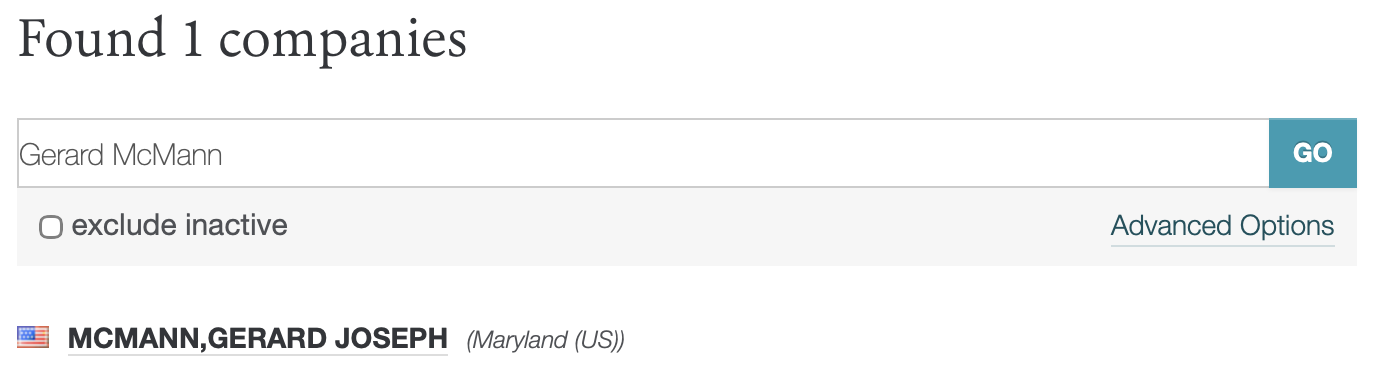
In any case, it is necessary to first identify the organization, so the next issue concerning Gerard McMann involves its legal registration. Alas, our subject lacks incorporation in any valid jurisdiction. Verification via OpenCorporates suggests the platform merely utilized open-source corporate registries to select a plausible business name during setup. This approach remains prevalent among fraudulent entities seeking quick financial gain. Cross-referencing the entity’s name yields a private firm incorporated in the State of Maryland, United States. Quite clearly, this registered entity bears no connection to the broker under review.
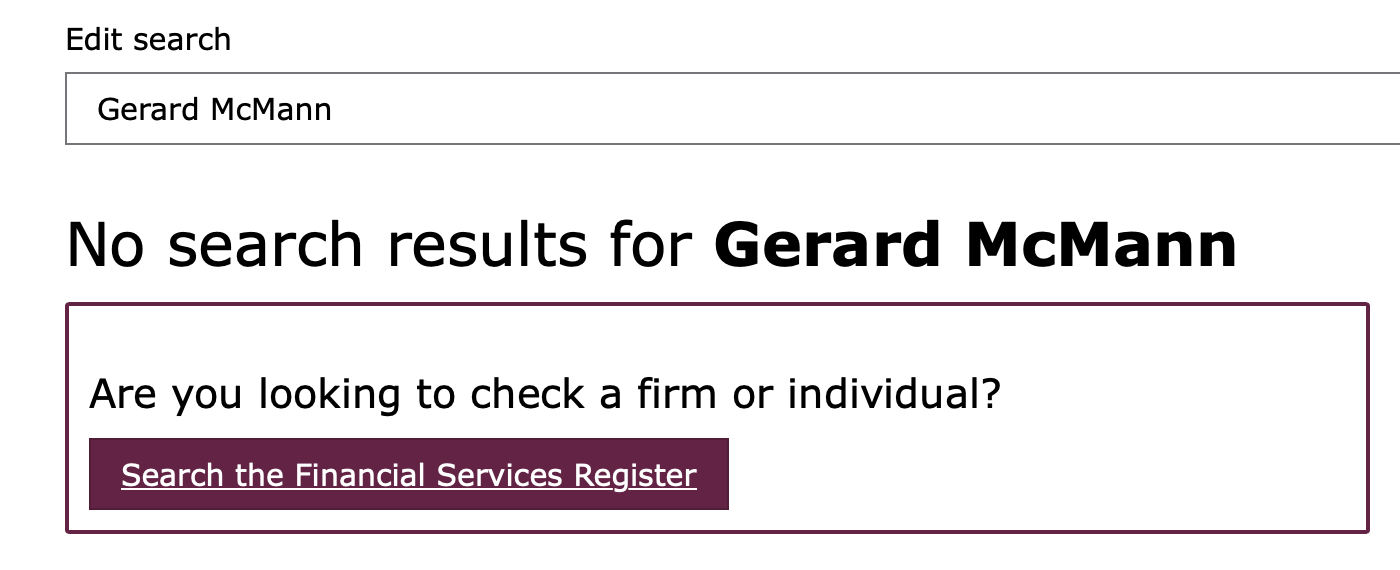
Thus, the absence of both regulatory licensing and corporate registration leaves client rights entirely unprotected. We would to note that while the company does not currently feature on the British Financial Conduct Authority (FCA) warning list, this reflects low brand visibility and regional focus rather than any underlying credibility.
Meanwhile, the Ontario Securities Commission is on the alert. On July 14, 2026, it issued a warning that the platform located at www.gerardmcmann.com is not authorized by Ontario authorities to handle securities. Thus, investors take an extreme risk when faced with a project that not only has no legal basis, but is also flagged by the financial commission.
Fake Awards and a Recycled Domain: Can You Trust the Claimed History?
Instead of a clear development history, the platform is filled with marketing hype about many years of successful work and various achievements. For example, it’s claimed that back in 2020, the platform received an award from Yahoo Finance as the Most Reputable Online Trading Company. We won’t even bother fact-checking such claims, especially since the managers provided no certificates, links, or photos of the awards. All we, and you, can admire in the “About Us” section are generic event photographs allegedly taken over time.
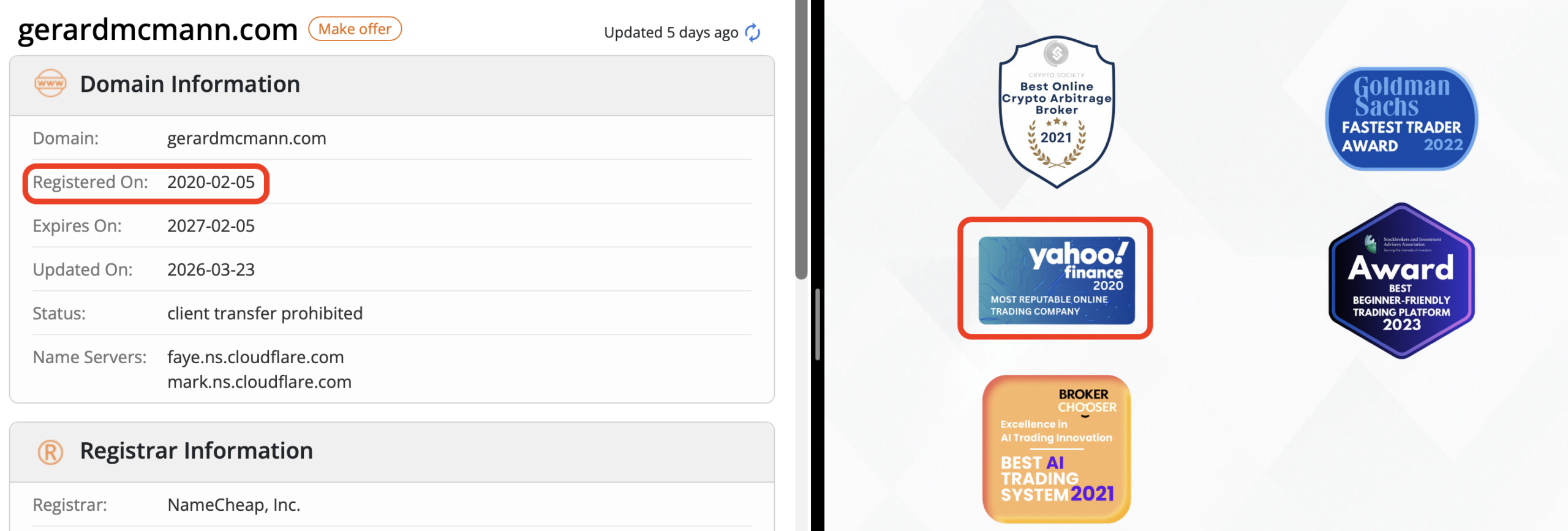
We are left to figure out the lifespan on our own. Because the project lacks a license, verifying an official regulatory issue date is impossible; the same applies to its non-existing corporate registration records. Nevertheless, establishing the true operational history of Gerard McMann proves relatively straightforward using WHOIS records and the WebArchive. Database queries indicate that the domain was initially registered in 2020. While WebArchive reflects entries prior to 2020, historical records confirm the domain was previously operated by an unrelated entity in China for entirely different purposes.

We decided to examine the WebArchive findings further, which revealed additional insight. Records indicate that between 2020 and 2025, the domain was associated with professional consulting. The very first snapshot with the current trading platform was made only on March 26, 2026. Consequently, genuine operation as a brokerage firm only commenced in 2026 — a factor investors must weigh heavily when evaluating the firm’s credibility.
Why do we believe that previous versions of the website are not related to the broker in question? Throughout the whole timeline, several core elements were altered at gerardmcmann.com:
- The layout and structure of the main landing page.
- The corporate logo.
- The primary line of business.
- The site content and offered services.
- The registration functions and support contact channels.
In short, we have established that the domain was utilized for entirely different purposes prior to 2026, making any historical industry awards factually impossible. This is a well-known trick: the creators of the Gerard McMann project acquired a domain with a solid history, thereby trying to gain legitimacy.
How Do Gerard McMann Managers Induce Deposits?
The broker exhibits the classic hallmarks of an aggressive boiler room operation, utilizing predatory tactics engineered to extract maximum capital from inexperienced traders.
First, the platform’s account structure functions as outright extortion. Gerard McMann employs a aggressive 9-tiered deposit ladder that escalates rapidly from an initial $250 minimum to $3,000, eventually stretching up to an absurd $250,000. Basic access to the trading interface remains strictly gated behind a mandatory deposit.
Worse still, the operators actively pitch “IRA Retirement Accounts” promising guaranteed, risk-free returns of up to 8%. How an unregulated CFD broker can guarantee risk-free yields on retirement products — without disclosing any underlying investment mechanisms — remains completely unexplained.
Second, the broker vaguely references referral schemes and bonus programs in its FAQ section while concealing all specific conditions. The website completely lacks a formal Bonus Policy, providing zero concrete figures or calculation rules. This deliberate lack of transparency serves either as cheap marketing fluff or, more dangerously, as a built-in legal pretext to block client withdrawals later on.
Off-Market Spreads, Hidden Leverage, and Useless Legal Disclaimers
As we previously highlighted, Gerard McMann’s account structure functions as an aggressive deposit ladder. These tiers do not offer genuine market execution options (such as STP or raw-spread ECN). You won’t find a single mention of liquidity providers or any conflict of interest (which certainly exists) on the website.
All the creators managed to disclose, aside from marketing services, is that exorbitant spreads start at 3.0 pips — making profitable trading virtually impossible. The advertised 1.6-pip rate is strictly paywalled for higher tiers, requiring thousands of dollars.
If you want a clear understanding of potential costs, including leverage ratios, margin call and stop-out levels, swaps and commissions, you can simply close your browser and get the same result. The project does not disclose these parameters, does not provide a specification table, and does not publish the regulations for trading operations. All of this raises the question of whether trades are actually taking place or whether this is just a bill-accepting website.
While the platform contains a dedicated educational area with basic FAQs and general partnership notes, access to structured webinars, comprehensive literature, or real-time market analysis is absent, rendering the educational resource minimal.
Moreover, Gerard McMann prefers the same ineffectiveness when it comes to internal documentation. The portal lacks Terms and Conditions, the standard regulations for any online broker. Instead, we’re left with some obscure Privacy & Policy. Indeed, clauses 1-6 address privacy issues, while the remaining clauses 7-19 concern trading. There’s no point in rejoicing anyway, because each clause is dedicated to no more than a couple of lines.

Let us scrutinize this legal text. We would like to highlight major red flags, effectively giving the operator a free hand to block funds and evade liability:
- Clause 15. The text explicitly disclaims all liability for financial losses and states that the broker does not guarantee the accuracy of platform data. In practice, if their closed terminal suffers slippage, freezes during volatile markets, or feeds manipulated quotes, clients have no legal recourse to recover losses.
- Clause 18: Gerard McMann reserves the right to suspend or terminate accounts for vague infractions like “unethical trading behavior.” Because the policy never defines what constitutes bad conduct, this clause serves as a built-in pretext to freeze profitable accounts or refuse withdrawal requests.
- Clause 17: The dispute resolution section slightly references legal channels in the relevant jurisdiction — without specifying a country, governing body, or court. If a conflict arises, traders are left with no identifiable legal entity or territory to file an official claim against.
- Clauses 3 and 14: The agreement allows the platform to pass client personal and financial data to third-party processors, yet fully disclaims responsibility for how those entities handle the information or funds. If money vanishes through an offshore payment gateway, Gerard McMann simply washes its hands of the matter.
Moving on, the Customer Identification Program Notice and Anti-Fraud Notice seemed promising but disappointing. The broker included a paragraph each describing the policies in very general terms. There is also a kind of ingenious Fraud Warning in which managers describe various types of Internet fraud, and also add that they, representatives of Gerard McMann, never behave in such a way.
Furthermore, the legal texts contain repetitive provisions, appearing structured primarily to increase document length rather than clarify terms.
Concealed Funding Terms and Forced Manual Onboarding
The company has not provided a payment processing policy, nor has it provided any AML/KYC information. No attempt was made to indicate the payment provider either. Again, all a potential client has to offer is a few cookie-cutter sentences in the FAQ section. There, Gerard McMann lists several transaction channels: credit/debit cards, bank wire transfers, digital assets, and internal account transfers. Stated processing times range from a few minutes to several hours depending on the chosen method, maximum up to 3 working days.
Given the mention of cryptocurrency networks, we assume that in reality all payments are processed this way, since the platform does not even have a legal entity capable of handling fiat funds.
While management claims zero deposit fees, such assertions require independent verification given the nature of the platform. Unfortunately, we have nothing more to study or check. Direct access to the clients area remains unavailable due to the absence of a functional online registration flow. Moreover, the website does not even have a login form, which again makes us wonder how deeply it is fake. Selecting the registration option redirects users to a generic inquiry form, effectively forcing prospective clients into direct, manual interaction with sales staff.
Recommendations for Investors
Gerard McMann is an illegal, blacklisted platform operating without regulatory oversight, meaning any capital deposited here carries an extremely high risk of total loss. We strongly recommend forget the broker and refusing to provide personal contact information or identification to their sales team. If you are contacted by company representatives, block them, and never install remote access software or make further payments. Finally, if you have already lost money, beware of fraudulent refund services that require upfront payment. If cryptocurrency payments were made, refunds are not possible.
Marketing Claims and Revealed Reality
The people who worked on the review
Each Broker Expert Audit review is based on publicly available evidence, including the broker’s website and legal disclosures, regulatory registers and official warnings, corporate and domain information, trading conditions, payment policies, and relevant user reports. Our writers investigate the available evidence, while editors fact-check key claims, verify sources, and ensure that risks and uncertainties are explained clearly. Read our full Methodology of Our Reviews.
Katherine Mercer is a financial editor and fact-checker with over a decade of experience handling brokerage claims and regulatory information. With a background in economics and financial compliance, she verifies the accuracy, consistency, and risk disclosure of all investigative articles. Her purpose is to ensure that each review is accurate, sourced reliably, and technically sound.
More about me →
stay away from gerard mcmann… registered last week deposited $250 and then their manager started calling every day pressuring me to upgrade to a $3k account for vip signals. when I asked to just withdraw my money they completely banned me. and then I searched and saw no license anywhere on the site either, so it was just a classic trap…