
PrimeNexusGate is an unregulated broker with highly opaque operating terms and no legal registration. The company lacks a license, information on trading parameters and liquidity providers, and its documentation raises serious concerns regarding client protection. Below, we outline the key risks and reasons why you should not entrust your funds to this platform.
- PrimeNexusGate: Regulatory and Operational Risk Profile
- Registration Check: Is PrimeNexusGate a Licensed Broker?
- PrimeNexusGate: Does Its Domain Age Match the Claimed Experience?
- Conflict of Interest and B-Book Risks
- PrimeNexusGate: Trading Conditions Are Nowhere to Be Found
- Deposits and Withdrawals: Opaque Rules and Inactivity Fees
- Recommendations for Investors
- Marketing Claims and Revealed Reality
PrimeNexusGate: Regulatory and Operational Risk Profile
| Target Brand & Domain | PrimeNexusGate (primenexusgate.com) |
| Risk Index | Critical |
| Legal Entity & Stated Jurisdiction | Unknown |
| Regulatory Status & License | Unregistered |
| Regulatory Blacklists | Not listed |
| Domain Age vs Claimed History | Created: 17/02/2026 (No history) |
| Trading Platform Software | Unknown |
| Deposit Methods & Chargeback | Closed Client Area (Chargeback unknown) |
Registration Check: Is PrimeNexusGate a Licensed Broker?
PrimeNexusGate discloses neither the legal name of the company allegedly behind the broker nor any registration details or license numbers. The only clue found is a reference to Switzerland in the contact information.
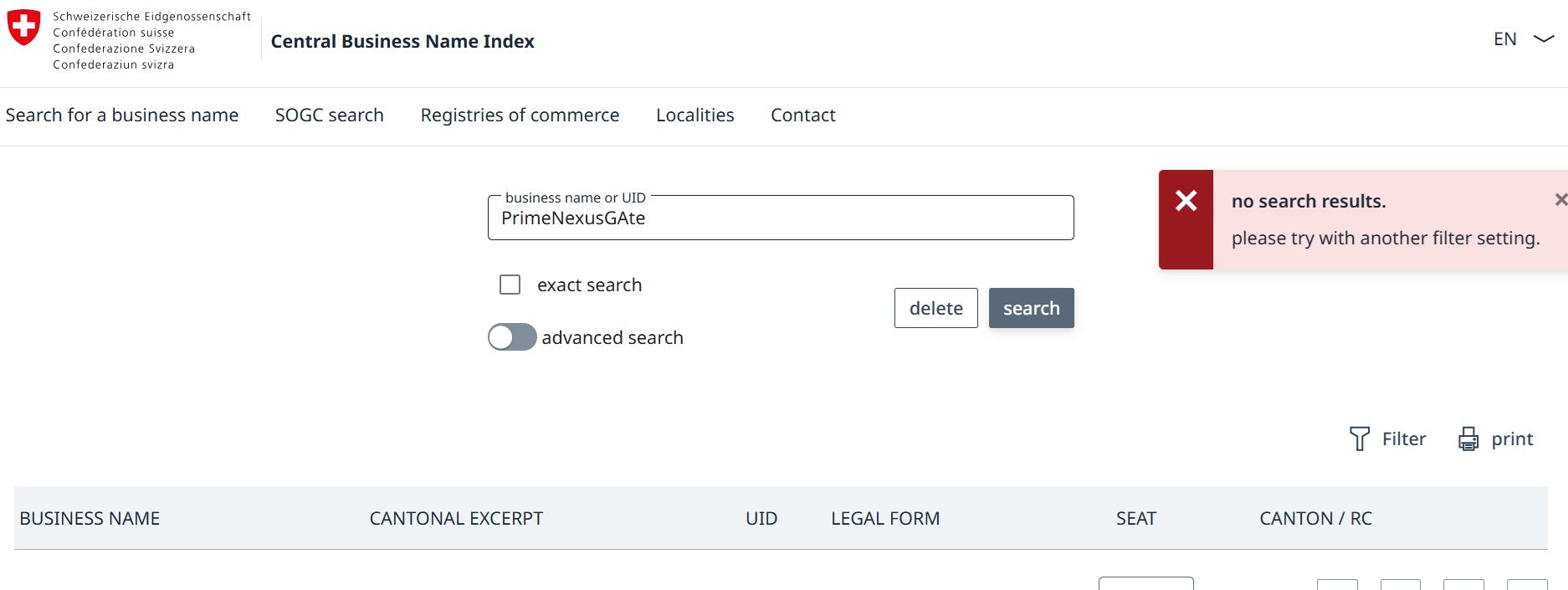
We checked available Swiss registries and found no trace of PrimeNexusGate or any legal entity that could be definitively linked to this broker. Consequently, there is no confirmation of Swiss registration or a license to provide brokerage services. Moreover, the broker makes no claim to hold a license and does not identify the regulator overseeing its operations.
This is a serious issue for a financial platform. A legitimate broker must enable clients to easily determine exactly which company is accepting their funds, where it is registered, and which regulator oversees its activities. In this case, even basic legal information is missing, making it impossible to verify the recipient of the trader’s funds.
Under these circumstances, there are no grounds to expect the standard client protection mechanisms available when dealing with regulated brokers.
PrimeNexusGate: Does Its Domain Age Match the Claimed Experience?
PrimeNexusGate offers virtually no clear account of its history or development. While the broker positions itself on its website as a reliable, professional platform, we found no concrete roadmap, founding date, details regarding the team’s prior experience, or other facts to substantiate these claims.
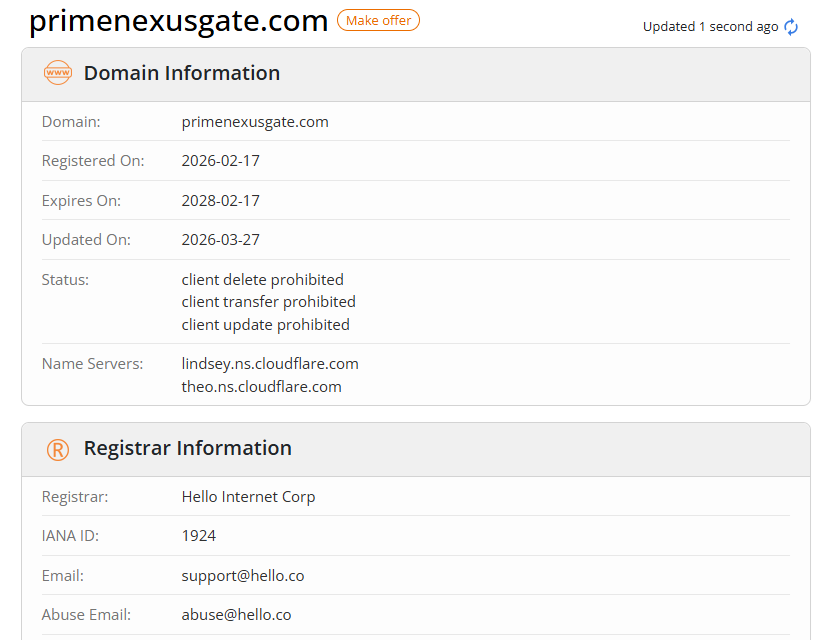
A domain check yields far more telling results. PrimeNexusGate only appeared online on February 17, 2026. In other words, at the time of our analysis, the project has not even been active for a full year. For an obscure financial platform asking clients to entrust it with their funds, this is an extremely short timeframe.
We have already established that the broker fails to disclose its legal entity, provide proof of Swiss registration, or offer information regarding any operating license. The situation paints a clear picture: a minimal digital footprint, an unknown operational history, and an absence of verified regulatory status. Under these circumstances, bold claims of professionalism and reliability carry little weight. If a long-standing financial institution were truly behind PrimeNexusGate, there would undoubtedly be verifiable information regarding its operations, management, registration, licensing, and reputation. Instead, we see a void where a digital footprint should be and a domain registered just a few months ago.
This is a classic pattern for projects that create an attractive facade first, only to attempt to persuade clients to entrust them with money later. Consequently, the story of PrimeNexusGate currently resembles the launch of yet another dubious brokerage venture rather than the operations of an established financial company.
Conflict of Interest and B-Book Risks
PrimeNexusGate’s conflict of interest agreement warrants particular attention. When a company acts as an intermediary for a client without explaining exactly how their trades are executed, a legitimate question arises regarding where the company’s financial interests truly lie.
Based on the available information, PrimeNexusGate exhibits all the hallmarks of a “B-Book” model. The broker provides no convincing evidence that client orders are routed directly to the interbank market, nor does it disclose specific liquidity providers or the counterparties and trading venues used for execution. Under this model, the broker acts as the direct counterparty to the client’s trade; consequently, if a trader loses money, that amount potentially becomes revenue for the broker. This is precisely where the most obvious conflict of interest arises: the financial outcomes for the client and the company are diametrically opposed.
The situation is further complicated by the fact that PrimeNexusGate offers exclusively CFDs. Unlike the purchase of an actual asset, a CFD is a derivative instrument; the trader does not own the underlying asset but merely opens a position based on its price movement. Therefore, it is crucial for such a broker to transparently disclose its execution model, quote sources, liquidity providers, and order-handling procedures.
This is precisely where PrimeNexusGate falls short. Clients are essentially invited to trade complex derivatives without receiving sufficient information to understand where their trades are routed or who acts as the counterparty. When combined with the lack of a license, this significantly exacerbates the potential conflict of interest.
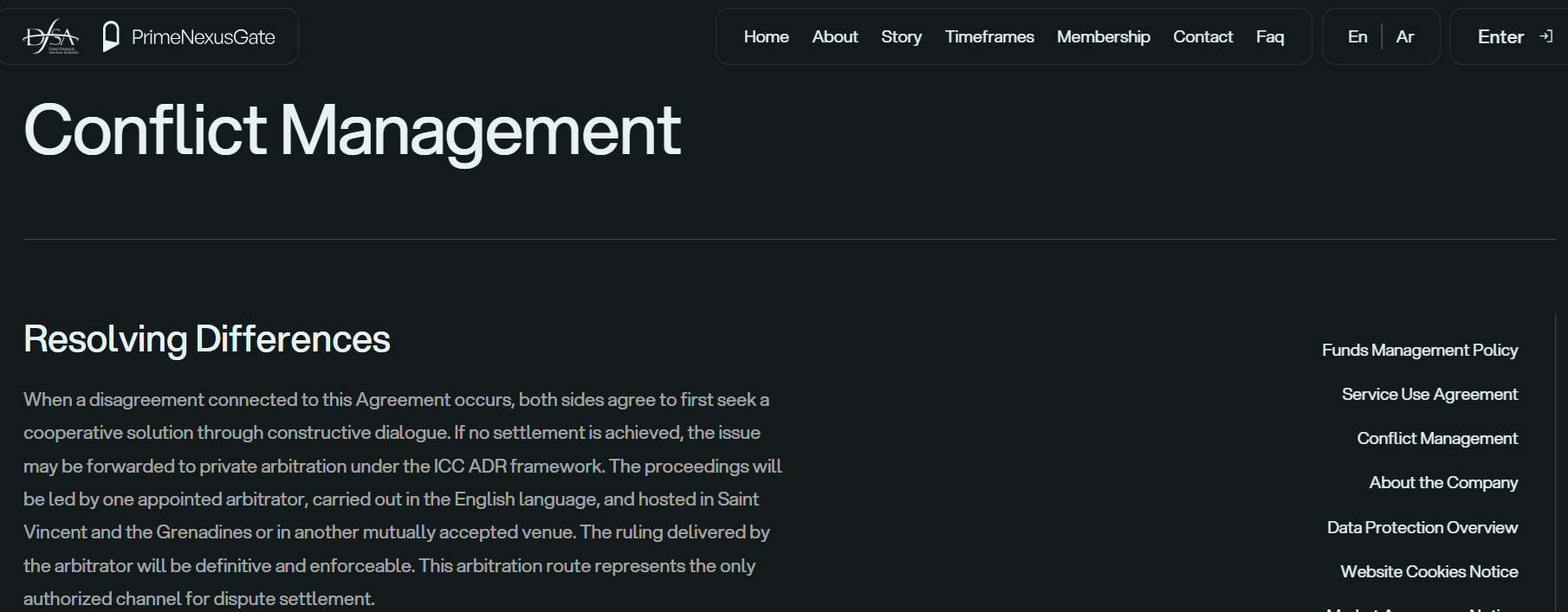
Regarding the conflict agreement itself, our PrimeNexusGate review reveals a particularly restrictive dispute-resolution mechanism. The “Resolving Differences” section effectively deprives clients of the right to choose how disputes are settled. While the agreement initially calls for an attempt to resolve conflicts through negotiation, any unresolved matter must proceed to private arbitration under ICC ADR rules. The case is heard by a single arbitrator in English, with the venue set in Saint Vincent and the Grenadines or another jurisdiction agreed upon by the parties. Most importantly, the arbitrator’s decision is declared final and binding. For an ordinary private trader, this procedure is far less accessible than filing a complaint with a financial regulator or local court. Arbitration may involve additional costs, legal assistance, and a significant time commitment, while proceedings in English create another substantial barrier for the client.
Why Saint Vincent and the Grenadines are involved at all, given that the broker purports to be Swiss — is a separate question.
The “Protecting Your Account” clause is even more concerning. In it, PrimeNexusGate absolves itself of liability for any damages, account misuse, or unauthorized transactions resulting from the client’s failure to adequately safeguard their login credentials. This allows the broker to cite inadequate credential protection regarding almost any disputed debit, effectively forcing the client to prove that the issue did not arise from their own negligence.
Finally, in the “Data Privacy and Complaint Procedures” section, the broker states that complaints should be directed to its own Complaints Department. In effect, the client is asked to first lodge a grievance with the very company whose actions are being challenged. There is no mention of an independent complaint resolution mechanism, a financial ombudsman, or a regulator that could be contacted should the company’s response prove unsatisfactory.
PrimeNexusGate: Trading Conditions Are Nowhere to Be Found
PrimeNexusGate’s trading conditions are frankly poor. PrimeNexusGate’s trading conditions raise serious concerns. The website does provide five account tiers — Basic, Growth, Advanced, Pro, and Master. Minimum deposits ranging from $10,000 to $250,000. However, the information provided for these accounts is largely limited to vague service descriptions such as personal supervision, market education, tailored trading notifications, a “No Loss Strategy,” and enhanced leverage options.
Crucially, the broker does not disclose the actual trading parameters behind these accounts. There is no clear information about spreads, commissions, swap rates, specific leverage levels, stop-out requirements, minimum trade volumes, or CFD contract specifications. Given the substantial deposits required to access these accounts, the lack of basic information about trading costs and conditions is particularly concerning.
The only document remotely resembling a client agreement is the “Terms of Use.” However, it reads more like the terms for a standard web service than a contract with a CFD broker. It details website usage, intellectual property rights, technical limitations, and even service subscriptions lasting one, three, or twelve months. Yet, it says almost nothing about what truly matters to a trader: order execution, settlement procedures, trading costs, position-closing protocols, and withdrawal terms.
The “Service Terms and Disclaimers” section is particularly odd. PrimeNexusGate states that services are provided on a prepaid basis and that, once activated, a subscription cannot be paused or refunded, even if the client never used it. For a site positioning itself as a brokerage platform, the mere presence of such clauses raises questions; the document gives the impression that it governs the sale of a digital service rather than the provision of financial services.
At the same time, the company goes to great lengths to limit its liability. The “Terms of Use” state that PrimeNexusGate is not responsible for errors or incomplete information, technical glitches, website outages, unauthorized server access, or a host of other circumstances. Additionally, the user agrees to indemnify the company against potential claims, losses, and expenses arising from, among other things, the use of the site and the information provided on it.
Deposits and Withdrawals: Opaque Rules and Inactivity Fees
The situation regarding deposits and withdrawals at PrimeNexusGate is not much better than its trading conditions. Although the broker has published a separate policy, it lacks specific details; it fails to list payment providers, banks, specific fees, transaction processing times, or payment agent details. From the published text, it is impossible to determine exactly who receives the client’s funds or who is actually responsible for transferring them.
PrimeNexusGate states that accounts may only be funded from a personal account registered in the client’s name within their country of residence. The broker reserves the right to request additional documentation to verify the client’s identity, account ownership, and the source of funds.
However, deposit and withdrawal methods are listed only in very general terms: bank transfers, bank cards, digital wallets, and, during registration, supported cryptocurrencies such as Bitcoin (BTC), Ethereum (ETH), and Litecoin (LTC). PrimeNexusGate discloses no specific payment systems, bank names, or payment agents. Even more significant is the broker’s reservation of the right to authorize alternative withdrawal methods subject to additional checks. Consequently, even the fundamental mechanism for moving funds remains undefined in advance.
The wording regarding fees also warrants special attention. PrimeNexusGate does not specify the amounts, stating only that processing times and transaction-related charges depend on the chosen payment method. For a trader, this information is virtually useless; before depositing funds, they cannot calculate the actual costs of depositing or withdrawing, nor do they know what charges might apply upon withdrawal.
The rule regarding inactivity is even more concerning. If an account remains inactive for three consecutive months, PrimeNexusGate begins deducting 10% of the remaining balance each month. In other words, prolonged inactivity could result in the client losing a significant portion of their funds simply for not trading. Furthermore, the text does not clarify what constitutes “activity” — whether a single trade suffices, if the rule applies to open positions, or if the deductions cease immediately upon the resumption of trading. If an account holds $10,000 and the client remains inactive for three months, the subsequent monthly deduction of 10% means the company gains the right to gradually deplete the client’s capital, even in the absence of trading losses. Moreover, PrimeNexusGate offers no clear economic justification for such a fee.
Finally, the policy allows for additional checks prior to fund withdrawals. When combined with the lack of legal information about the company and the absence of transparent payment details, this appears particularly risky. It is also impossible to verify what the broker actually offers inside the client area, as all buttons on the website redirect users to a login form, while no registration form is available anywhere on the site.
Recommendations for Investors
PrimeNexusGate does not disclose its legal entity or confirm the possession of a license. We found no evidence of regulated brokerage activity on the company’s part. Furthermore, the broker does not disclose its liquidity providers or trade execution model. Trading conditions and payment infrastructure also remain largely unknown.
Therefore, we do not recommend entrusting funds or documents to this broker. If you have already sent funds, do not transfer additional money under the pretext of fees or to unblock withdrawals. We also remind you not to trust offers to recover funds in exchange for an upfront payment, as this could be a recovery scam.
Marketing Claims and Revealed Reality
The people who worked on the review
Each Broker Expert Audit review is based on publicly available evidence, including the broker’s website and legal disclosures, regulatory registers and official warnings, corporate and domain information, trading conditions, payment policies, and relevant user reports. Our writers investigate the available evidence, while editors fact-check key claims, verify sources, and ensure that risks and uncertainties are explained clearly. Read our full Methodology of Our Reviews.
Katherine Mercer is a financial editor and fact-checker with over a decade of experience handling brokerage claims and regulatory information. With a background in economics and financial compliance, she verifies the accuracy, consistency, and risk disclosure of all investigative articles. Her purpose is to ensure that each review is accurate, sourced reliably, and technically sound.
More about me →
The managers are extremely pushy! Once I left my contact details, they started constantly calling and messaging with offers to open an account and make a deposit. They don’t seem to take no for an answer at all. I’ve had to ask them multiple times to stop contacting me!!!