

WealthGAF is a high-risk broker lacking a verified license that has already been placed on the UK FCA’s warning list. The regulator explicitly warns that the company may be offering financial services illegally. To understand why dealing with this project could result in financial loss, let us examine its legal status, trading conditions, and handling of client funds.
- WealthGAF: Regulatory and Operational Risk Profile
- Legal Reality: Who Is Behind WealthGAF?
- Claimed Experience vs. Actual Digital Footprint
- How Does WealthGAF Hide Its Real Operating Model?
- Trading Conditions: The Higher the Deposit, the Greater the Privileges
- Deposits and Withdrawals: No Clear Way to Fund or Recover Your Money
- Recommendations for Investors
- Marketing Claims and Revealed Reality
WealthGAF: Regulatory and Operational Risk Profile
| Last Updated | 05/06/2026 |
| Target Brand & Domain | WealthGAF (wealthgaf.info) |
| Risk Index | Critical |
| Legal Entity & Stated Jurisdiction | WealthGAF Group, Inc |
| Regulatory Status & License | Unregistered |
| Regulatory Blacklists | Warned by FCA (29/06/2026) |
| Domain Age vs Claimed History | Created: 19/03/2026 (Claimed: Since 2018 year) |
| Trading Platform Software | Unknown |
| Deposit Methods & Chargeback | Closed Client Area (Chargeback unknown) |
Legal Reality: Who Is Behind WealthGAF?
The WealthGAF website contains virtually no information regarding the platform’s legal status. The only substantive mention appears in the footer. The broker claims that its assets are serviced by WealthGAF Brokerage Services, a division of WealthGAF Marketing Corporation, which allegedly holds membership in FINRA and SIPC. However, WealthGAF provides no registration number, license details, corporate address, or other data that would allow for the verification of this entity.
It is particularly telling that the broker does not even provide a proper user agreement. There is no document setting out the terms governing the relationship between the client and the company actually providing the financial services. So clients have no information about their contractual rights and obligations.
FINRA (Financial Industry Regulatory Authority) is a US self-regulatory organization that oversees broker-dealers and registered brokers in the United States. FINRA membership is indeed significant; it implies that a company holds the appropriate status and can be verified via the official BrokerCheck system.
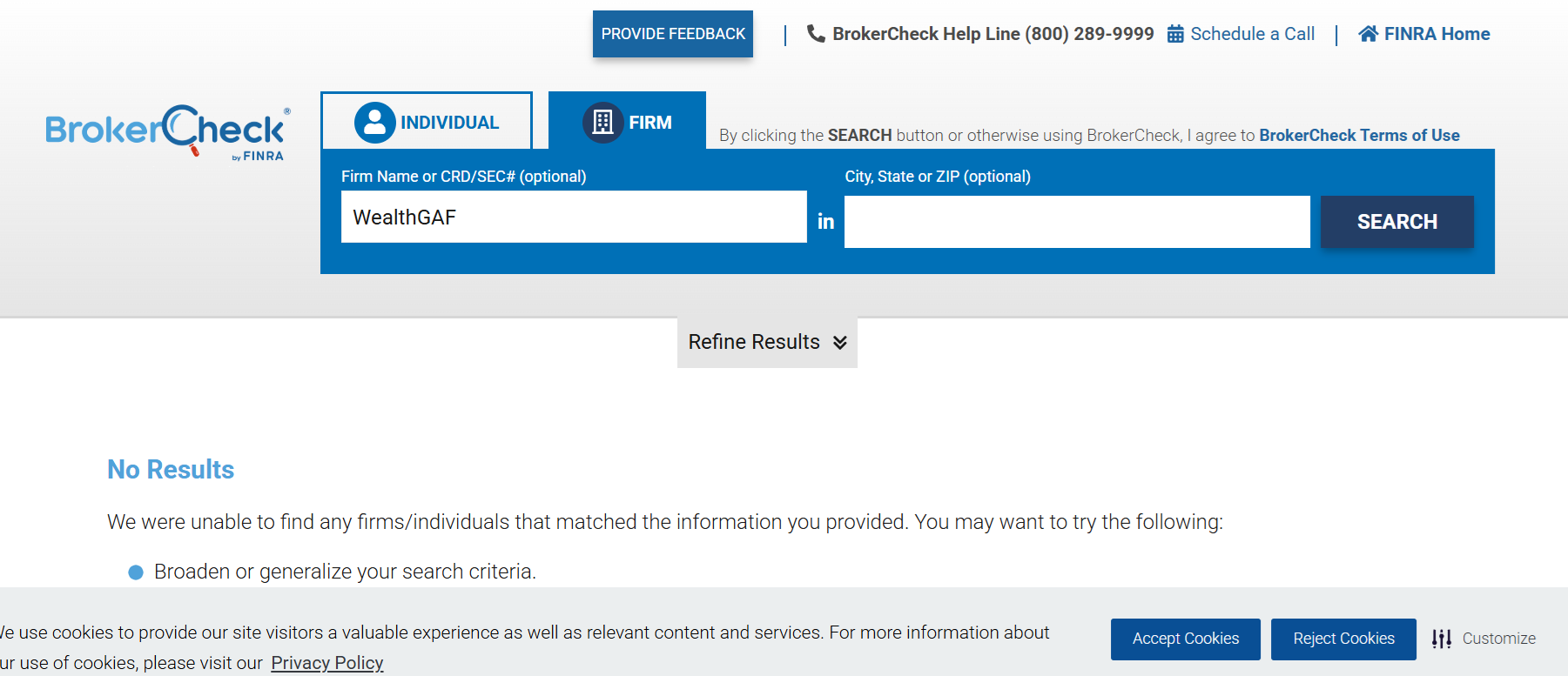
However, public FINRA databases contain no confirmation that such a company is a registered broker or an FINRA member. Furthermore, there is no evidence confirming the existence of the claimed “WealthGAF Brokerage Services” as a division of that organization.
Consequently, WealthGAF is effectively leveraging the names of a US regulator and an investor protection system without providing any proof of an actual affiliation with them.
SIPC is not a regulator, nor does it issue licenses to brokers. It is a US system designed to protect the clients of specific registered broker-dealers; therefore, a reference to SIPC is meaningful only if the brokerage company’s status can be independently verified.
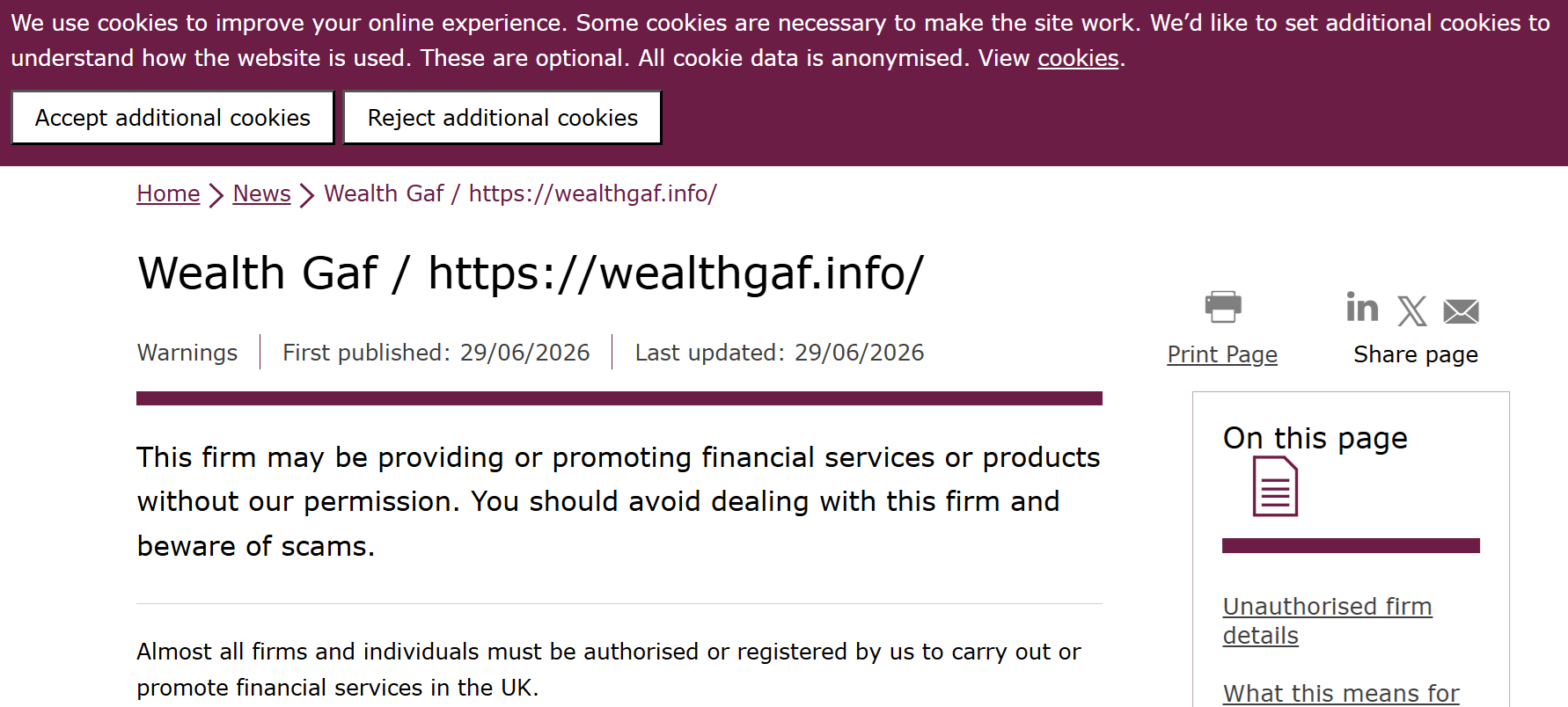
The situation has become even more serious following a review of information from the UK regulator, the Financial Conduct Authority (FCA). On June 29, 2026, the FCA issued a warning regarding Wealth GAF and the domain wealthgaf.info, noting that the company is promoting financial services without the necessary authorization.
The regulator explicitly states that WealthGAF is not authorized by the FCA and may be targeting UK clients. The FCA also advises against dealing with this firm and warns of potential fraud risks.
Claimed Experience vs. Actual Digital Footprint
WealthGAF attempts to project the image of a long-established international financial company. The website displays a host of impressive figures: the broker claims to have won “Top 50 Investment Companies” awards between 2018 and 2022, boasts a trading volume exceeding $1.7 million, an average monthly turnover of over $84 billion, a client base spanning more than 180 countries, over seven offices, and a partner network of more than 20,000 members.
The problem is that there is no evidence to substantiate these claims. If the company had truly been operating since 2018, serving clients in over 180 countries, and handling such volumes, one would expect to find a significant digital footprint — including articles, mentions in financial media, archived versions of the website, numerous customer reviews, and other independent testimonials. Instead, information about WealthGAF is extremely scarce, and there are so few reviews that it is impossible to speak of a reputation built over several years.
An examination of the domain itself is even more revealing. According to WHOIS data, wealthgaf.info was registered only on March 19, 2026. This means the site appeared online very recently, contradicting claims of awards dating back to 2018 and years of international operations.
Ultimately, the claimed accolades from 2018–2022, the presence in 180+ countries, the seven-plus offices, and the multi-billion dollar turnover are completely inconsistent with the project’s actual digital footprint. A registration date of March 19, 2026, represents a negligible amount of time for a company attempting to portray itself as an international financial giant with a long-standing history.
How Does WealthGAF Hide Its Real Operating Model?
WealthGAF exhibits several red flags that warrant a particularly close look at how the platform interacts with its clients. Let’s start with communication. Instead of a standard range of support channels, the broker offers virtually nothing but a contact form. There is no dedicated phone number, clear office address, functional email, or other transparent means of contacting the company promptly. Social media icons are also displayed on the site; however, they link only to the main pages of the respective platforms rather than to specific PS Wealth profiles. This creates the impression that they have been included merely for the sake of appearances. Moreover, the website lacks even Terms & Conditions, a document that should define the relationship between broker and client, covering details such as who accepts the funds, how trades are executed, what commissions apply, how withdrawal requests are processed, and who bears liability in the event of a dispute.
The absence of such a document is truly appalling for a financial venture. Clients are asked to entrust their money to a platform that does not even explain the legal basis of the relationship.
Clients have no grounds to believe that their trades are actually routed to the external market. Every trade is executed via the “B-Book” model; given this lack of transparency, it is impossible to verify whether trades are being passed through to the interbank market. All of this creates a direct conflict of interest between the broker and the client. Under this arrangement, the broker acts as the counterparty to the client’s trades and profits whenever the client incurs a loss.
Trading Conditions: The Higher the Deposit, the Greater the Privileges
WealthGAF offers seven service tiers, divided into “Basic” and “Advanced” categories. Instead of providing a standard description of trading parameters, the broker essentially sells clients a package of privileges based on the size of their deposit. The minimum entry threshold is $5,000, while the VIP tier requires $1 million.
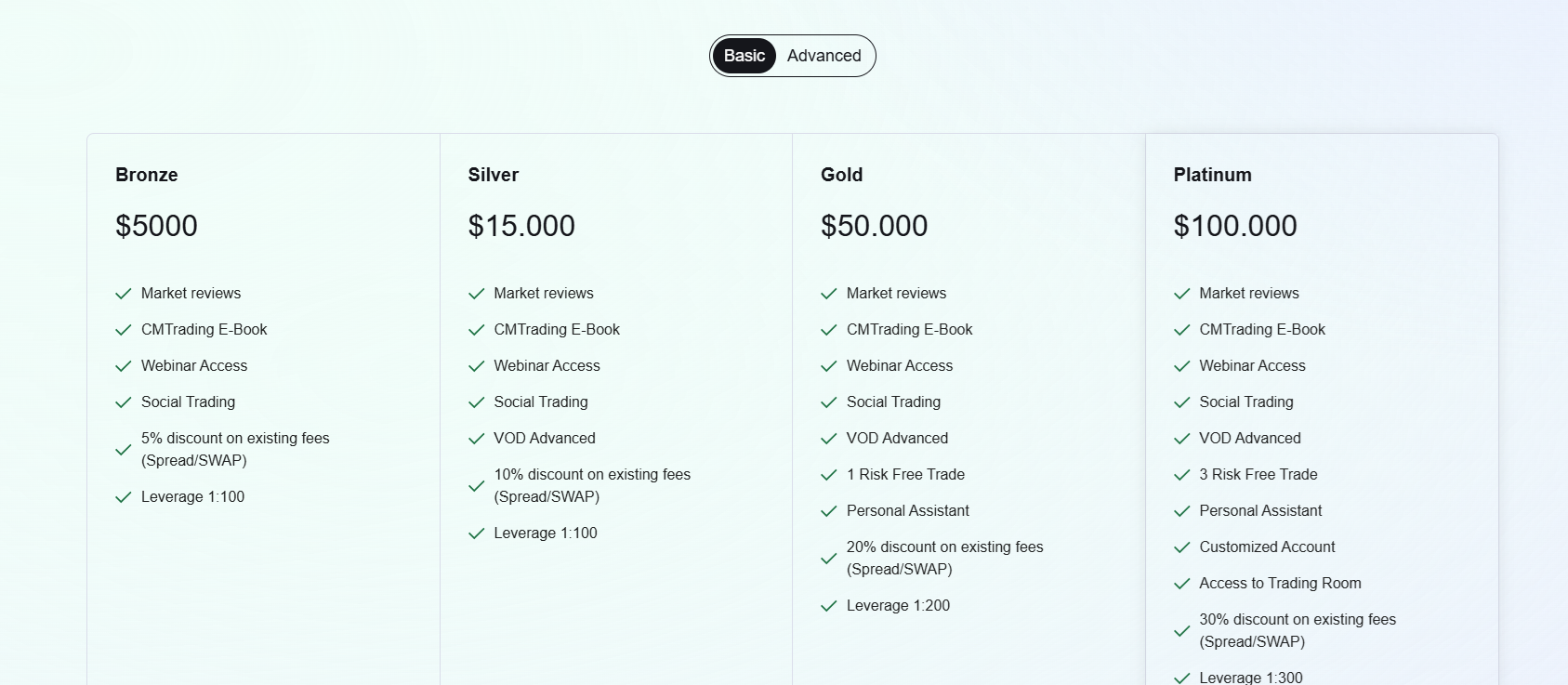
In our WealthGAF review, we found that the Bronze level requires a minimum deposit of $5,000. The package includes market reviews, a CMTrading e-book, webinar access, and social trading. Clients are also promised a 5% discount on existing spread and swap fees, while leverage is capped at 1:100. However, the broker never discloses the actual rates of these fees, leaving clients unable to determine the base amount from which the 5% discount would be calculated or assess the real value of the offer. The inclusion of a CMTrading e-book is also peculiar for WealthGAF, as it involves third-party branded material without any explanation.
The Silver tier requires $15,000. Clients receive all the previous benefits, plus “Advanced VOD” content and a 10% discount on spreads and swaps. However, leverage remains unchanged at 1:100; tripling the minimum deposit results in no change to this key trading parameter. Furthermore, instead of specifying actual spreads, swaps, and commissions, the broker again offers only a percentage discount without revealing the underlying rates.
The Gold tier requires $50,000. This level introduces one “Risk-Free Trade,” a personal assistant, and a 20% discount on spreads and swaps, while leverage increases to 1:200. The term “Risk-Free Trade” is particularly questionable: the broker fails to explain what such a trade entails, the maximum compensation amount, who covers the loss, or the conditions under which the client receives compensation. Without these details, the term remains more of a marketing promise than a clear financial condition.
The Platinum tier requires a $100,000 deposit. In addition to all previous benefits, the client is promised three “Risk-Free Trades,” a personal assistant, a customized account, and access to the Trading Room. The discount on spreads and swaps increases to 30%, and leverage rises to 1:300. However, the fundamental situation remains unchanged: exact trading costs are still unknown, and the terms governing risk-free trades are not disclosed. Given that this involves a six-figure deposit, the lack of specifics becomes a particularly serious issue.
Next come the “Advanced” levels. The Diamond tier requires $250,000. The client receives three “Risk-Free Trades,” a personal assistant, a customized account, and a trading specialist, while the discount on spreads and swaps increases to 40%. Leverage remains at 1:300. Essentially, adding another $150,000 to the Platinum deposit yields no increase in leverage; the benefit lies primarily in extra services and a discount whose economic value cannot be assessed without published commission rates.
The Premium tier requires $500,000. Here, the discount rises to 60%, and the client retains the three “Risk-Free Trades,” personal assistant, customized account setup, and trading specialist. Leverage remains at 1:300. In other words, the broker asks the client to tie up half a million dollars without disclosing even the basic parameters needed to evaluate trading costs.
Finally, the VIP tier is designed for clients with a deposit of $1,000,000 or more. They are offered a massive 90% discount on spreads and swaps, three “Risk-Free Trades,” a personal assistant, a customized account, and a trading specialist. Leverage is listed simply as “Individual,” meaning no specific figure is provided at all. This is particularly telling. Even for a client with a million-dollar deposit, it is impossible to know in advance what leverage will be offered or exactly what terms will apply.
The main problem with this entire system is that deposit requirements are disclosed far more clearly than the actual trading conditions. WealthGAF provides detailed information on the funds needed to advance to the next tier but fails to publish precise data on spreads, commissions, swaps, minimum trade volumes, stop-out levels, margin requirements, and other parameters essential for objectively assessing trading costs and risks.
The spread and swap discounts are particularly odd. For a discount to have any practical meaning, the client needs to know the base spread and swap rates. If the broker does not disclose the base rate, a promised discount of 5%, 40%, or even 90% reveals nothing about the actual costs. Theoretically, one could set an arbitrarily high base commission and then offer a massive discount, yet the final cost could still be steep.
Finally, the Risk-Free Trade feature is one of the most concerning aspects of the offer. WealthGAF does not clarify whether this entails a loss rebate, a bonus, insurance, or merely a marketing label. There is no information regarding the maximum compensation amount, validity period, eligible instruments, or the conditions for receiving a payout. Consequently, a client seeing a promise of three “risk-free trades” might take it literally, even though the published information implies no actual legal protection against losses.
Deposits and Withdrawals: No Clear Way to Fund or Recover Your Money
The situation regarding deposits and withdrawals at WealthGAF appears equally problematic. The website lacks any clear description of the payment infrastructure; there is no information on available deposit methods, the banks or payment systems processing transfers, the currencies accepted, or applicable fees. Withdrawal policies are also unpublished; it is unclear what methods are used for payouts, how long processing takes, whether there are minimum or maximum limits, what documentation might be required to verify a transaction, or under what circumstances the company might restrict or reject a client’s request.
With a legitimate, regulated broker, payment procedures should not remain a mystery until the moment funds are deposited. A client needs to know in advance exactly where their funds are going, who the payment recipient is, and the terms under which they can withdraw their money. Here, however, such information is virtually non-existent.
The registration process is also unnecessarily cumbersome. It requires clients to complete a large number of questionnaires. Although the broker states that login and password will be sent to the registered email address, no such credentials are received after registration.
Recommendations for Investors
WealthGAF does not display registration details or licenses, so one cannot expect comprehensive oversight by a financial regulator. Consequently, investors cannot rely on standard client protection mechanisms, such as compensation in the event of withdrawal issues.
We do not recommend opening an account with WealthGAF or transferring funds to them until their legal status and regulatory standing are verified.
If you have already transferred funds and are facing withdrawal difficulties, do not send additional money under the guise of taxes, fees, or account unblocking charges. You should also exercise caution regarding offers from “fund recovery specialists”; after a financial loss, scammers often employ “recovery scams,” promising to return your deposit in exchange for an upfront payment.
Marketing Claims and Revealed Reality
The people who worked on the review
Each Broker Expert Audit review is based on publicly available evidence, including the broker’s website and legal disclosures, regulatory registers and official warnings, corporate and domain information, trading conditions, payment policies, and relevant user reports. Our writers investigate the available evidence, while editors fact-check key claims, verify sources, and ensure that risks and uncertainties are explained clearly. Read our full Methodology of Our Reviews.
Katherine Mercer is a financial editor and fact-checker with over a decade of experience handling brokerage claims and regulatory information. With a background in economics and financial compliance, she verifies the accuracy, consistency, and risk disclosure of all investigative articles. Her purpose is to ensure that each review is accurate, sourced reliably, and technically sound.
More about me →
👍👍👍 They’re just very professional at feeding people a line.